
Deputy vs Tanda: which one suits you (Australia)
Updated 2 September 2026•8 min read

Written by
Steve Harris
Which one suits you
We reviewed both platforms hands-on and scored them across the same twelve categories. Unlike most pairings in this category, these two are close: no category separates them by more than 1.5 points, and they tie outright on time tracking. The differences are concentrated in two places.
Deputy is stronger where the roster and the phone are the job — 9.0 for rostering and 9.1 for mobile apps, the highest mobile score in any of our competitor reviews. Tanda is stronger on what happens after the shift — 8.3 for reporting against 7.8, and a timesheet approval screen that gates each shift on named compliance checks before it is payroll-ready. Tanda also carries the better user-ratings score, 8.9 against 8.2.
Read the full workings in our Deputy review and Tanda review. Scores below are our assessment from testing, not a vendor claim.
How they scored in our hands-on reviews
Both reviews use the same twelve-category framework and both score every category, so these columns are directly comparable. Each score links to the reasoning behind it in the relevant review.
| Category | Deputy | Tanda |
|---|---|---|
| Rostering | 9.0 /10 | 7.5 /10 |
| Time tracking | 8.5 /10 | 8.5 /10 |
| Payroll | 8.1 /10 | 7.6 /10 |
| Communication | 7.4 /10 | 7.9 /10 |
| Mobile apps | 9.1 /10 | 7.6 /10 |
| HR tools | 7.0 /10 | 7.4 /10 |
| Reporting | 7.8 /10 | 8.3 /10 |
| Pricing | 7.0 /10 | 7.1 /10 |
| Use cases | 8.4 /10 | 7.8 /10 |
| Security | 8.6 /10 | 8.2 /10 |
| Support | 7.4 /10 | 6.9 /10 |
| User ratings | 8.2 /10 | 8.9 /10 |
Source: our own reviews of Deputy and Tanda. Both carry their own overall score and full reasoning.
Where the gap is widest
Four categories separate them by half a point or more. Two favour Deputy, two favour Tanda, and they split cleanly along the line between building a roster and closing one out.
Rostering — Deputy 9.0, Tanda 7.5
Joint-widest margin on the board, level with mobile apps, and Deputy's strongest suit. Our review found site-based scheduling with demand forecasting, auto-scheduling and multiple roster views. Tanda's roster is functional rather than exceptional — see the rostering section of our Tanda review.
Mobile apps — Deputy 9.1, Tanda 7.6
The highest single score we gave either platform. If your staff interact with the roster mainly through a phone — swapping shifts, clocking on, checking next week — this is the gap most likely to show up day to day. See our assessment of Deputy's apps.
Reporting — Tanda 8.3, Deputy 7.8
Tanda's clearest advantage, and it matches what the interface shows: reports grouped into named categories with filters, rather than a smaller fixed set. See the reporting section of our Tanda review.
User ratings — Tanda 8.9, Deputy 8.2
A different kind of evidence from the rest of this table: it aggregates public review-platform sentiment rather than our own testing. Tanda rates between 4.4 and 4.8 out of 5 across the Xero App Store, G2 and Capterra AU.
What the two products look like
Screenshots from our own trial accounts, not vendor marketing renders — Deputy captured December 2025, Tanda January 2026. They show where each tool puts the same job, which is usually more telling than a feature table. Both vendors ship changes continuously, so treat these as a record of what we saw on those dates rather than a guarantee of what a trial shows today.
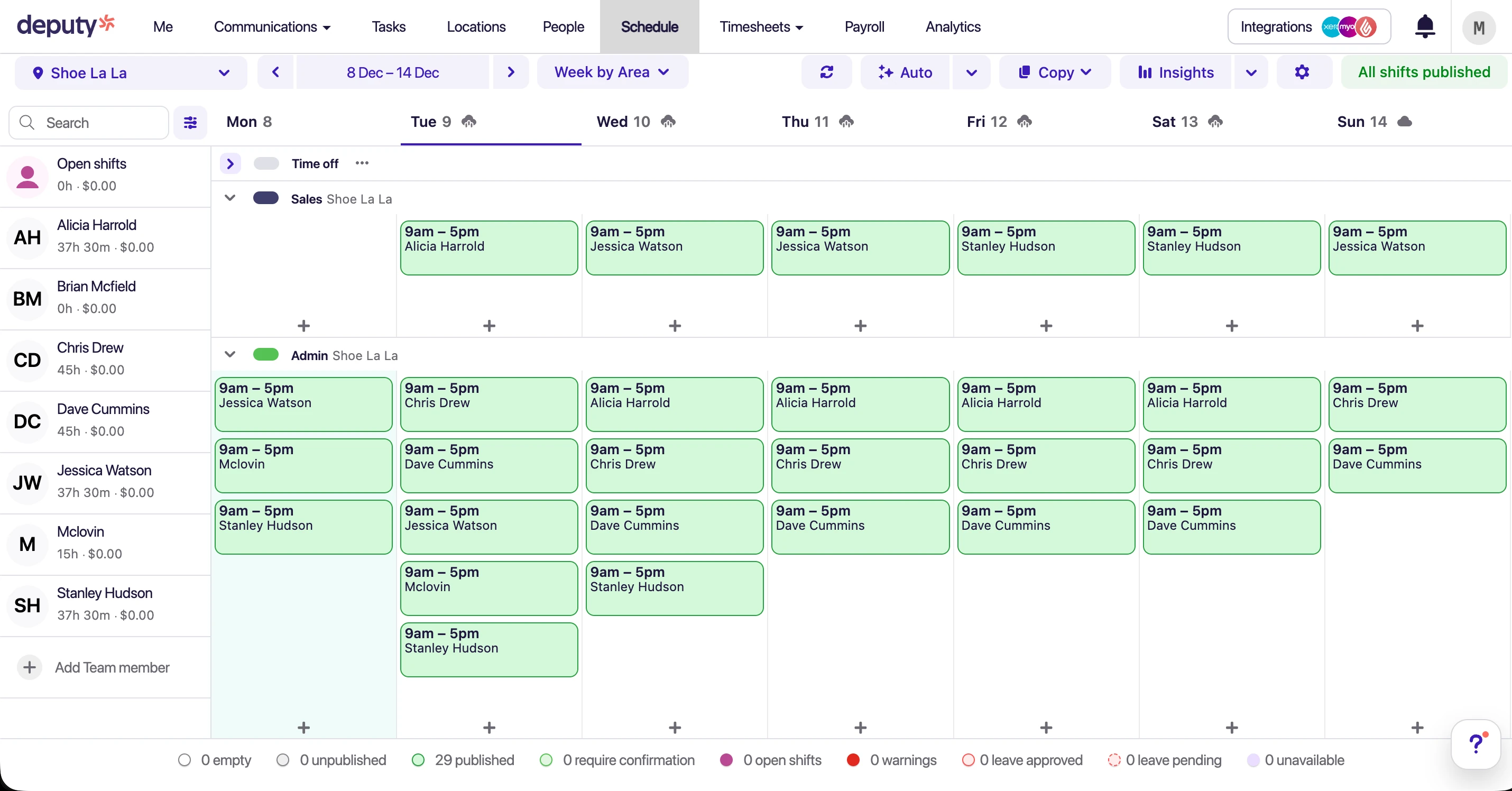
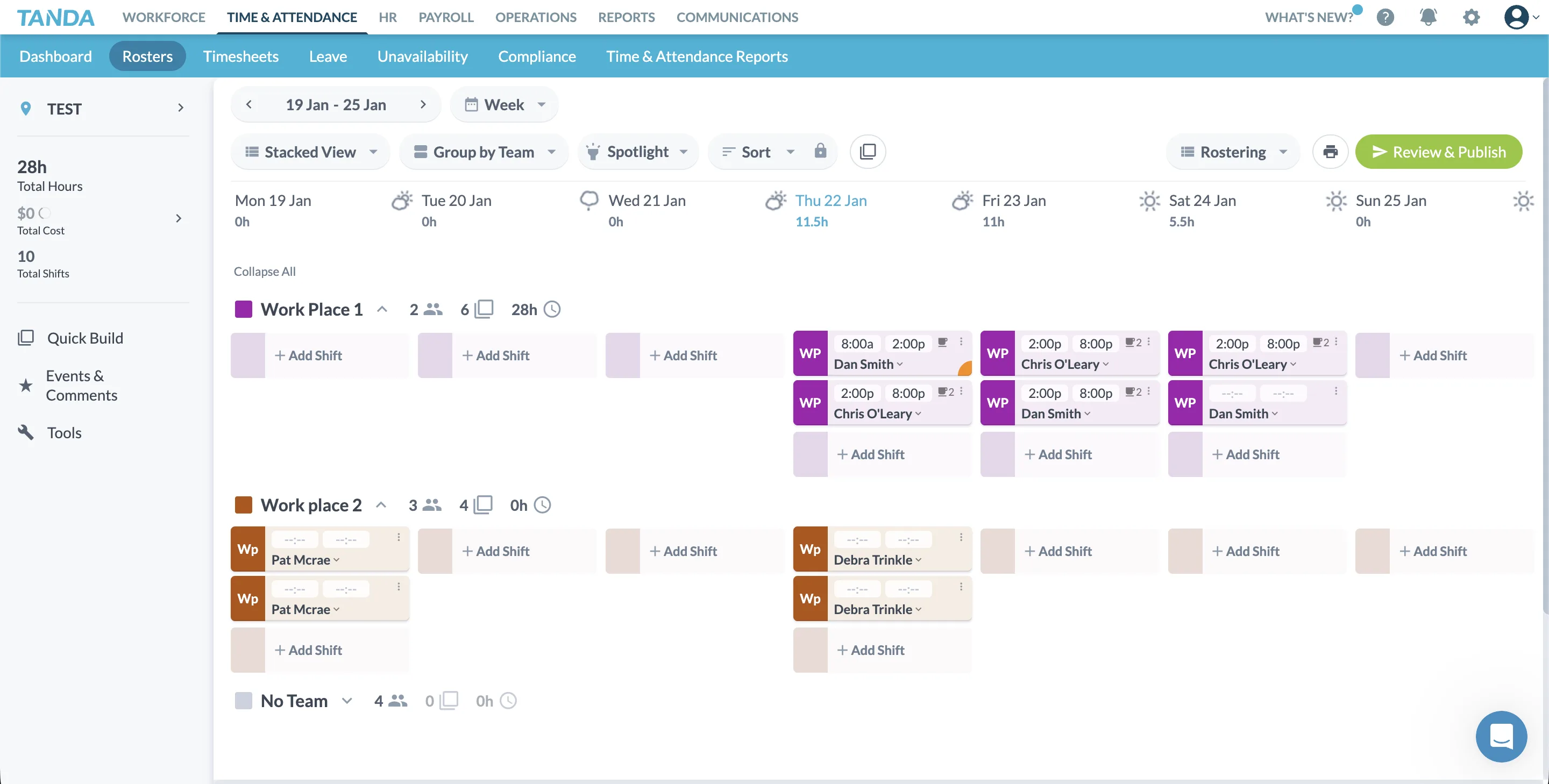
Building the roster
Both use a grid, but they orient it differently: Deputy runs staff down the side, Tanda groups by team and surfaces running hours and cost in the left rail.
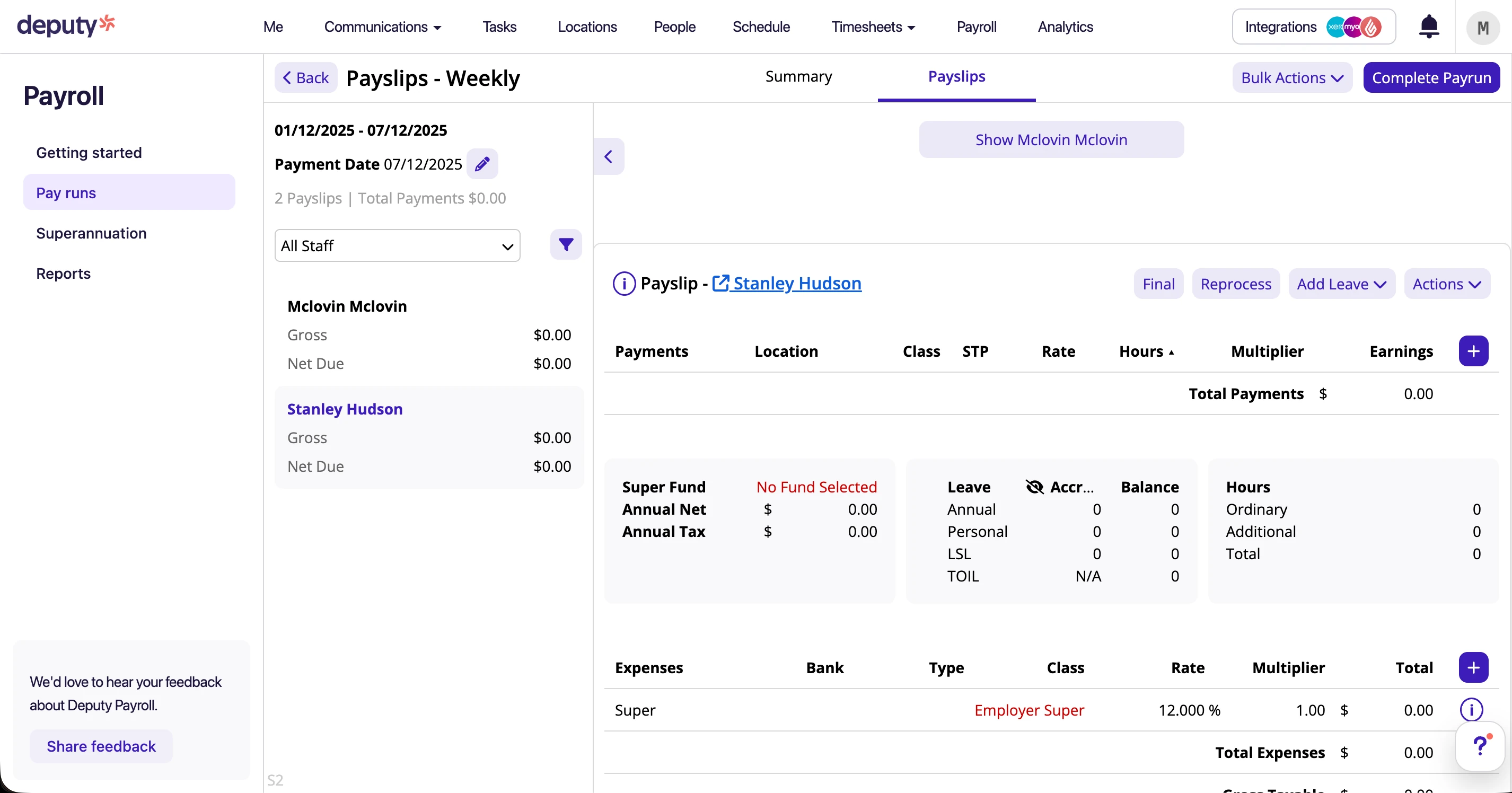
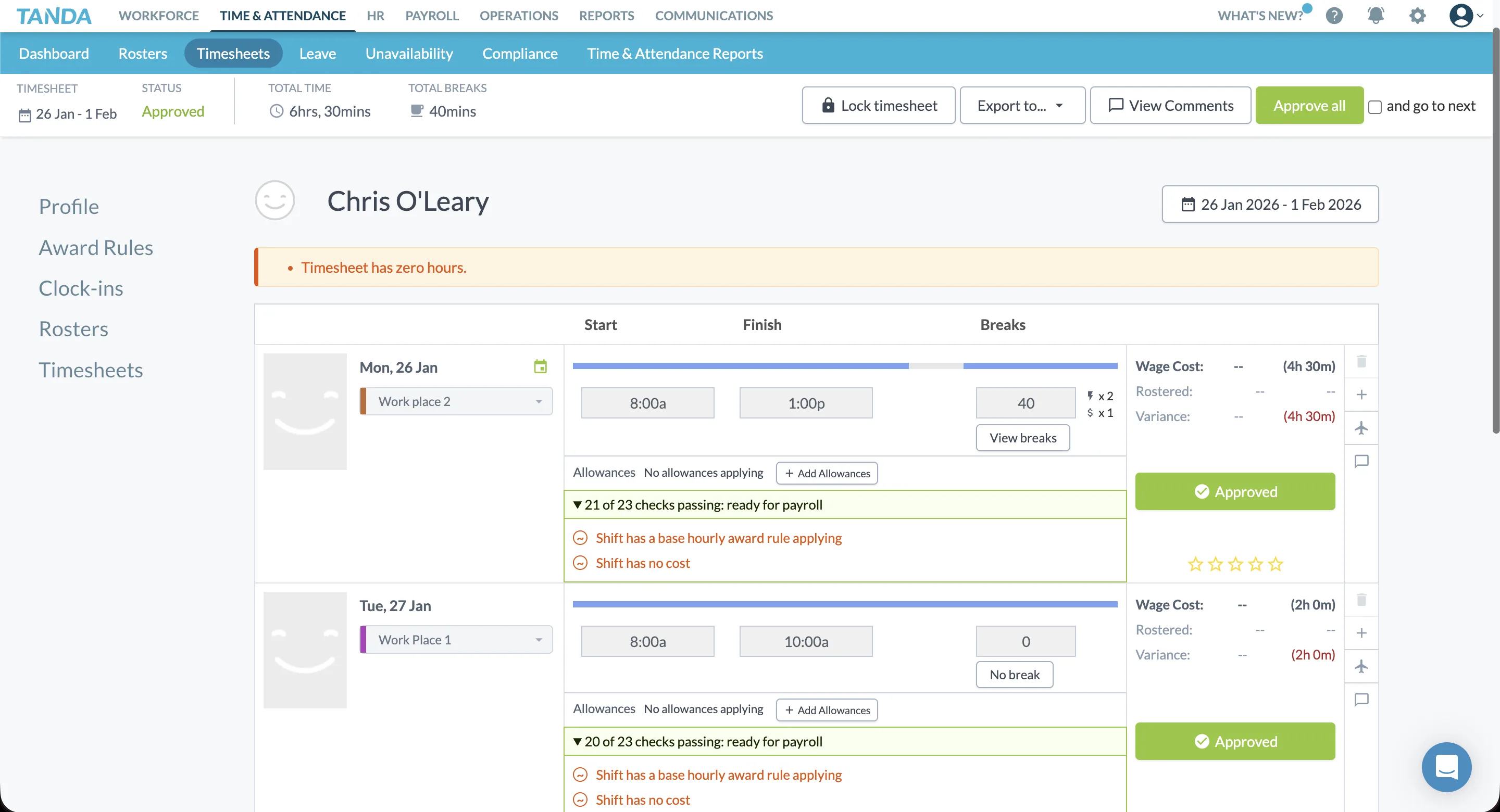
Turning approved time into pay
Two halves of the same job: Deputy assembles payslips in a pay run, Tanda gates approval on per-shift compliance checks.
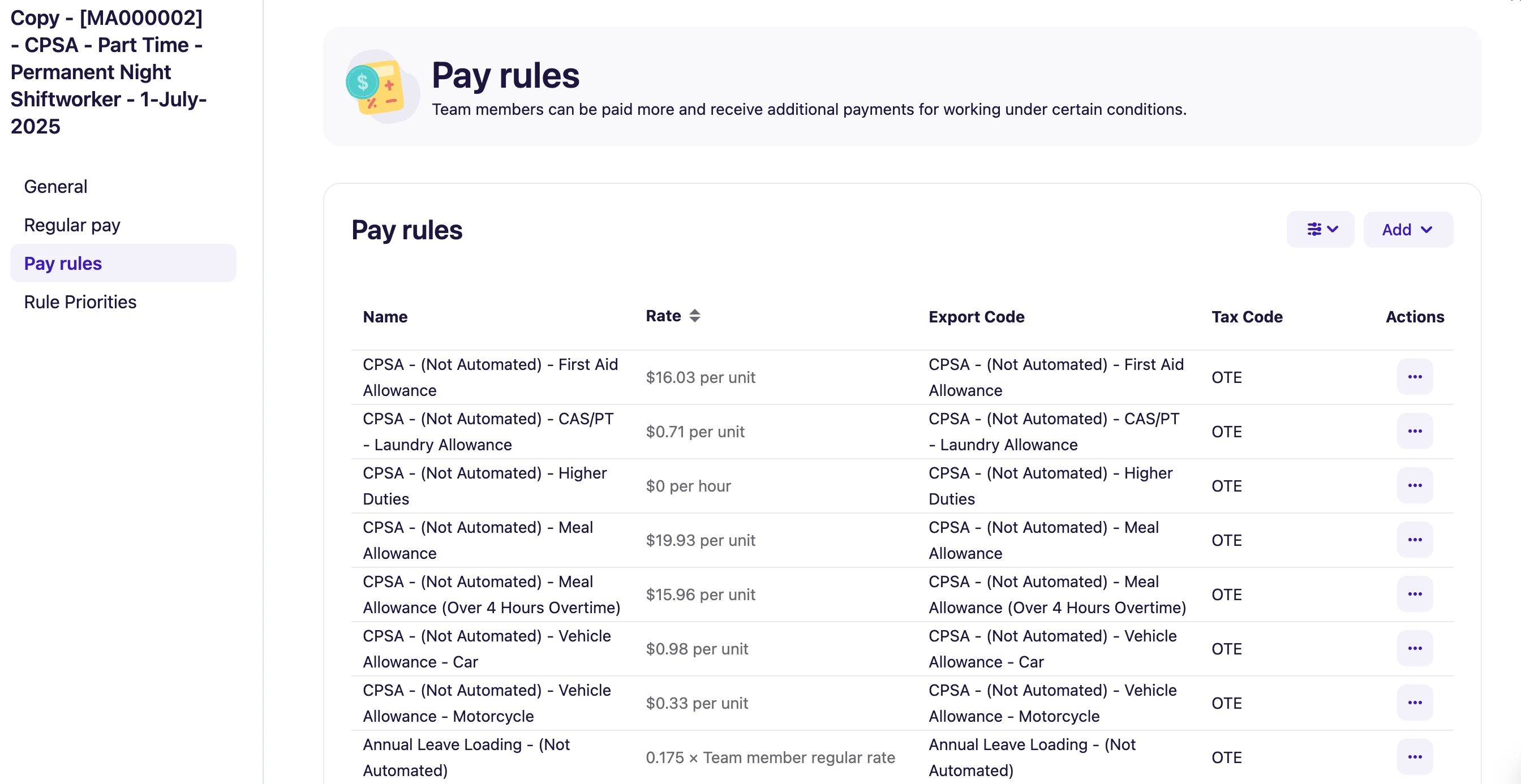
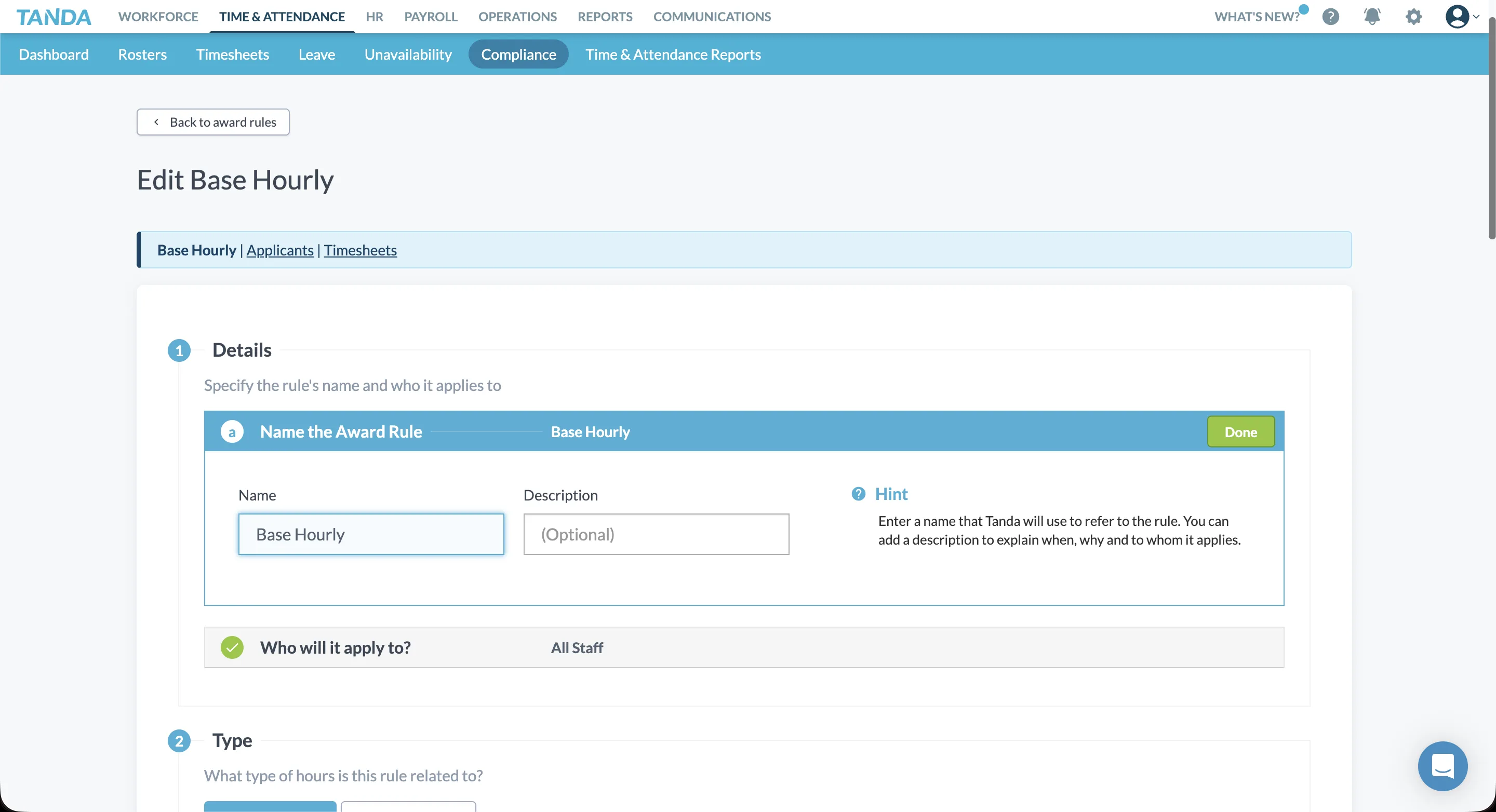
Award interpretation setup
Both vendors state that they interpret modern awards. What differs is how much of the rule set you configure yourself.
What each vendor publishes
Each row states what the vendor puts on a public page — separate from our scores above, which are our own assessment. A question mark means we could not confirm it from a public source; it is not a claim that the capability is missing.
| Deputy | Tanda | |
|---|---|---|
| Pricing model | Three per-user tiers (Lite/Core/Pro) plus four paid add-ons, priced separately | One bundled per-user price covering HR, payroll and workforce management; individual modules on request |
| Published entry price | $6.75 per user/month, AUD excl GST (Lite) | $12.80 per user/month +GST (All in One) |
| Minimum spend | AUD $30 per month per invoice on monthly Lite, Core and Pro | No minimum spend stated on the public pricing page |
| Native payroll in the base price | Payroll is a paid add-on at $5 per user/month on top of the plan | Payroll is named as part of the bundled price |
| Annual billing discount | Deputy states "Save 10% annually" against its add-ons | Not stated on the public pricing page |
| Enterprise tier | An Enterprise tier is listed alongside Lite/Core/Pro | Not named on the public pricing page; module pricing is "on request" |
Sources: Deputy AU pricing and Tanda pricing pages, read 21 August 2026.
Pricing
The clearest difference here is not a feature, it is the shape of the bill. Deputy sells a core platform and prices payroll, HR, messaging and analytics separately. Tanda sells one bundle. That makes the headline prices misleading in opposite directions. Every figure below is quoted from the vendor's own published pricing page, read on 21 August 2026.

Deputy
Per user per month, AUD excl GST
Everything you need to get started with scheduling and time tracking
Advanced tools to streamline operations and boost productivity
Complete control with powerful automation, insights, & priority support
Add-ons, priced on top
- Payroll $5
- HR $3.50
- Messaging+ $2.75
- Analytics+ $2
Minimum monthly spend of AUD $30 per invoice on monthly Lite, Core and Pro.
Deputy's AU pricing page
Tanda
Per user per month, +GST
HR + payroll + workforce management in one price
Tanda invites you to request individual module pricing rather than publishing per-module rates.
Tanda's pricing pageReading the price difference
Deputy's entry price is roughly half Tanda's. That comparison only holds if you want rostering and time tracking and nothing else, because Tanda's figure already includes payroll and HR.
The same shopping basket, using each vendor's published rates
- Rostering and time tracking only — Deputy Lite $6.75. Tanda does not publish a workforce-management-only rate; you would need to request module pricing.
- Add payroll and HR — Deputy Lite $6.75 + Payroll $5.00 + HR $3.50 = $15.25. Tanda All in One = $12.80. Both pre-tax, per user per month.
Deputy's $30 monthly invoice minimum also matters below about four users, where it sets the bill regardless of the per-user rate.
Xero App Store ratings
Public, dated and specific to the Australian Xero marketplace — a different signal from our own scores above.
Deputy
3.9/5 (147 reviews)
Tanda
4.5/5 (51 reviews)
What we could not verify
Comparison pages usually assert far more than their author can actually check. Here is what we deliberately did not claim, and why.
- The scores are ours, not the vendors'. They come from our own hands-on testing and reflect our judgement. A business that weights reporting over rostering would rank these two differently using exactly the same numbers.
- Award interpretation depth. How each product applies modern award rules sits in help-centre documentation. Both help centres return HTTP 403 to non-browser clients, so we could not read them and have made no claim either way.
- Tanda's module pricing. Only the All in One price is published; per-module rates are quoted on request, so a module-level comparison is not possible from public sources.
- Implementation, onboarding and contract terms. Not measurable from published material.
Where RosterElf fits
We build RosterElf, so treat this section as what it is. If you are weighing Deputy against Tanda, the third option worth a look is a platform built around Australian award interpretation with a single per-employee price and no add-on ladder.
See Deputy vs RosterElf, our Deputy review and Tanda review, or the best rostering software in Australia guide.
Our review methodology
Learn how we evaluate workforce management platforms through hands-on testing and verified user feedback.
Feature comparisons are checked against each vendor's public documentation at the time of writing. Assessments of usability, fit and value are our reviewers' opinions, not statements of fact, and products change often. We'd encourage you to trial both platforms and judge for yourself. Spotted something out of date? Tell us and we'll correct it .
Deputy vs Tanda: frequently asked questions
- On our own hands-on testing Deputy scores higher where the roster itself is the job — rostering 9.0 against 7.5, and mobile apps 9.1 against 7.6. Tanda scores higher on reporting (8.3 vs 7.8), communication (7.9 vs 7.4) and user ratings (8.9 vs 8.2). They tie on time tracking at 8.5. Which matters more is a judgement about your business, not a fact about the products.
- Rostering and mobile. Those were our two highest scores for Deputy — 9.0 for rostering and 9.1 for mobile apps, the highest mobile score we gave either platform. If managers build the roster daily and staff live in the app, that is where Deputy earns its place on a shortlist.
- Reporting and the compliance checks around timesheets. We scored Tanda 8.3 for reporting against Deputy's 7.8, and its timesheet approval screen gates each shift on a set of named checks before it is payroll-ready. Tanda also holds the higher user-ratings score, at 8.9 against 8.2.
Start your free 15-day RosterElf trial today
Join 30,000+ Australian workplaces using RosterElf to simplify rostering, payroll and HR.