
Written by
Steve Harris
Choosing the right workforce management platform isn't just a software decision — it affects labour costs, staffing reliability and day-to-day operations. This guide provides a comprehensive workforce management software comparison between RosterElf and Deputy, focusing on scheduling, time and attendance, payroll integration and compliance features that matter most to Australian shift-based businesses.
Deputy and RosterElf take different approaches to scheduling, compliance and payroll, making the choice highly dependent on business size and complexity.

Read our honest Deputy review 2026
In-depth analysis of Deputy's pricing, rostering, time tracking, payroll integration, and mobile apps.
Read full reviewQuick summary
Deputy is a global workforce management platform known for its advanced AI-assisted scheduling, strong labour-law and Fair Workweek compliance tools, and broad international coverage backed by a large integration ecosystem. Its modular plans let businesses choose scheduling, time & attendance, or combined premium functionality through the newer Lite, Core and Pro tiers.
RosterElf is an Australian-built rostering, HR and payroll-prep platform designed for shift-based SMEs, offering drag-and-drop rostering, a mobile and kiosk time clock, award interpretation, and strong Xero and MYOB payroll integrations, with an optional HR layer for contracts, policies and onboarding.
Pricing & plans
Both platforms offer monthly and annual billing, but their pricing structures differ in complexity. RosterElf is positioned as Australian scheduling software designed around Fair Work compliance and Xero/MYOB workflows. It uses a single core plan with an optional HR add-on, while Deputy offers three plan tiers and several additional paid modules.
For clarity in this review, we compare RosterElf with Deputy Core (the most commonly selected plan) and then outline how each platform handles the key add-ons that influence overall cost.
How RosterElf and Deputy price their plans
Deputy pricing page


RosterElf pricing
Core
Rostering and time & attendance
Payroll-ready timesheets & awards
per user per month
every active employee, logged in or not
+ GST, billed monthly
Start free trial See all featuresFull Suite
Rostering, payroll & HR in one
Payroll & HR tools in one system
per user per month
every active employee, logged in or not
+ GST, billed monthly
Start free trial See all featuresHR
HR tools only
Onboarding, documents & policies
per user per month
every active employee, logged in or not
+ GST, billed monthly
Start free trial See all featuresMonthly billing: minimum 3 staff. Annual billing: minimum 10 seats. All prices exclude GST. Contact us for enterprise pricing (250+ employees).
Monthly price comparison (Deputy core plan vs RosterElf)
| Deputy | RosterElf | |
|---|---|---|
| Core plan | $8.75 | $8.00 |
| HR | $3.50 (add-on) | $2.00 (add-on) |
| Messaging | $2.75 (add-on) | $0.00 (included) |
| Analytics+ | $2.00 (add-on) | $0.00 (included) |
| In-Built Payroll | $5.00 (add-on) | N/A (Xero/MYOB) * |
| TOTAL (per user/month) | $22.00 | $10.00 |
* RosterElf doesn't offer built-in payroll and instead integrates with external systems like Xero and MYOB.
Annual price comparison (Deputy core plan vs RosterElf)
| Deputy (Annual) | RosterElf (Annual) | |
|---|---|---|
| Core plan | $8.75 | $6.00 AUD + GST |
| HR | $3.15 (add-on) | $1.00 (Full Suite upgrade) |
| Messaging | $2.48 (add-on) | $0.00 (included) |
| Analytics+ | $1.80 (add-on) | $0.00 (included) |
| In-Built Payroll | $4.50 (add-on) | N/A (Xero/MYOB) * |
| TOTAL (per user/month) | $20.68 | $7.00 AUD |
* RosterElf doesn't offer built-in payroll and instead integrates with external systems like Xero and MYOB.
Deputy v RosterElf pricing summary
RosterElf's pricing follows a simple structure: Core plan at $8 AUD per employee/month (or $6 on annual billing) covers rostering, time and attendance, GPS/photo clock-ins, award interpretation, Xero/MYOB payroll integration, messaging and basic analytics. The Full Suite at $10/month ($7 annual) adds HR tools including onboarding, contracts, and compliance tracking.
Deputy's pricing is more modular. The Core plan is $8.75 AUD per user/month, but several functions equivalent to RosterElf's inclusions—such as HR ($3.50), Messaging+ ($2.75), Analytics+ ($2.00), and in-built payroll ($5.00)—are billed as separate add-ons. When combined, the total monthly cost reaches approximately $22.00 AUD per user, which is about 120% higher than RosterElf's monthly total for the same feature coverage.
On annual billing, the pattern is similar. Deputy's combined Core + add-on pricing totals around $20.68 per user/month, compared with $7 per employee/month for RosterElf Full Suite, a difference of roughly 195%.
These differences reflect the contrasting pricing philosophies of the two platforms. RosterElf consolidates most day-to-day workforce management needs into a single plan with one optional add-on, while Deputy separates more functionality into individual modules. For Australian shift-based SMEs that use rostering, attendance and payroll exports together, RosterElf typically results in a lower overall cost. Deputy may be better suited to larger or more complex organisations that prefer selecting specific modules or require advanced forecasting and compliance features.
⭐ Verdict: RosterElf is the better value for most Australian SMEs because it includes more features in its base price and has fewer paid add-ons. Deputy becomes significantly more expensive once equivalent modules are added.
RosterElf is better for:
- Low, predictable pricing
- SMEs wanting all-in-one value
Deputy is better for:
- Larger teams needing optional modules
- Organisations preferring a modular pricing model
Rostering & scheduling
Both platforms function as scheduling software for small businesses, offering tools designed to reduce admin time and improve shift coverage. However, they take different approaches to layout, usability and how much information is surfaced on the screen.
A key consideration for Australian businesses is Fair Work-aware rostering. RosterElf approaches this through award-aware shift rules, while Deputy relies on configurable templates and fatigue alerts.
For clarity in this review, we analyse the core elements that influence daily roster creation—views, shift detail, filtering, automation and the overall scheduling experience.
RosterElf vs Deputy: scheduling comparison
This section examines how RosterElf and Deputy approach day-to-day rostering, including layout, usability, views, shift detail, filtering and advanced scheduling tools.
Both platforms offer core rostering and scheduling functionality, but they approach it differently.
Roster layout & first impressions
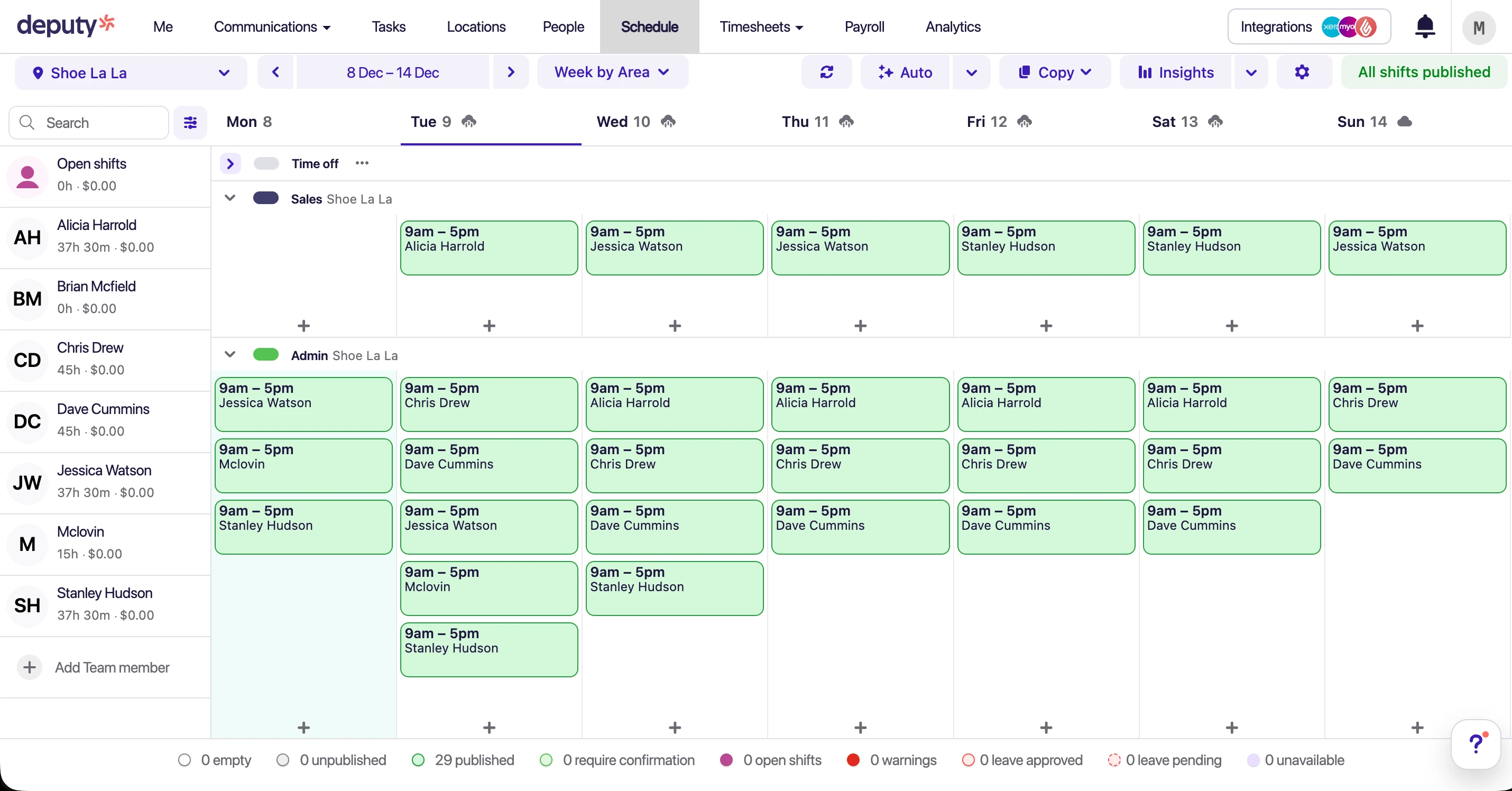
Deputy labels its roster as a "Schedule" to suit its global audience. The default view displays staff in a left column and shifts in the central grid, with key actions positioned along the top. While the layout is structured, there is a noticeable separation between the staff list and the shift grid. The staff panel shows only weekly hours and cost by default, requiring an extra click to access further detail.
RosterElf keeps terminology local to AU/NZ, using "Roster". The layout places staff vertically on the left with their shifts aligned horizontally, making it immediately clear who is working and when. Colour separation between shifts and rows makes the roster easier to scan at a glance. Shift cells show more information up front—including site, position, shift time and breaks—reducing the need to click into each shift.

Shift detail & information density
Deputy shows fewer details directly on the grid—typically area and location—and does not display break information in the roster view. This means more clicking is required to confirm the full shift.

RosterElf compresses more detail into each shift tile (e.g., site, role, time, break duration), giving managers more context without opening a modal.

Roster views & navigation
RosterElf
- Daily, weekly, fortnightly and monthly views
- Staff, site, and position views built in
- Filters are placed within the roster screen
- One-click "clear filters" option
- Ability to show live availability and approved leave directly on the roster
Deputy
- Daily, weekly and a two-week view
- Staff, site and area views
- Filters accessed via an external sidebar
- Monthly view displays days horizontally like RosterElf
- Leave shown in a separate "On Leave" section rather than integrated
RosterElf's inline filtering makes scenario-based roster adjustments faster (e.g., view one site + one position + only published shifts). Deputy allows site-based filtering but cannot filter positions within a site to the same level of detail.
Adding, editing & repeating shifts
Deputy uses a modal interface for creating shifts, but the flow is more involved, requiring additional steps such as marking a shift open or open-with-approval. Employee selection isn't filtered or searchable inside the modal, which can slow things down for larger teams, and shift analytics aren't displayed. Positions are location-specific, so multi-site operators often need duplicates. Deputy does, however, provide more flexible repeat patterns, with the ability to schedule several weeks in advance.

Adding a shift in RosterElf is a single-step process: click, enter shift details, adjust break time, add notes, and review suggested staff with their average rate. Shift-level analytics are displayed directly inside the modal, giving instant cost and suitability insights. Repeating a shift or assigning multiple staff can also be done from the same screen.

RosterElf vs Deputy: scheduling automation
Deputy includes Auto-Scheduling, which can generate a schedule using regular patterns, shift structures or by filling empty shifts. While powerful, the feature provides limited in-flow guidance and some help links were found to be non-functioning during testing. This can make the tool harder to adopt without prior training—particularly on Lite plans that lack chat support.

RosterElf does not offer AI-driven Auto-Scheduling, but it includes a "Perfect Match®" recommendation that selects the most suitable staff based on site, role, availability and qualifications. This is simpler and more transparent than Deputy's automation, though less advanced.

RosterElf vs Deputy: labour cost comparison
In Deputy, budgeting lives inside the Insights area instead of the roster itself, which means managers can't see cost implications as they build shifts. While Insights offers sophisticated forecasting tools—including sales projections, labour models and required staffing levels—the feature set comes with little on-screen guidance and no contextual support links.

RosterElf includes budgeting directly within the roster, allowing managers to see real-time updates to hours, labour cost, average rates and labour percentages as shifts change. Filters such as site, position or staff immediately update the budget view, providing quick cost clarity. The key limitation is that budgets are set at the account level, not individually per site.

Publishing, loading & performance
During testing, RosterElf allowed publishing from within the active roster view and also supported publishing individual shifts directly from the modal. Deputy's publishing workflow involved multiple screens and noticeable loading times when applying templates or confirming publication.
| Specific feature | RosterElf | Deputy |
|---|---|---|
| Rostering views | ||
| Daily view | ✅ Yes | ✅ Yes |
| Weekly view | ✅ Yes | ✅ Yes |
| Fortnight view | ✅ Yes | ❌ Not standard |
| Monthly view | ✅ Yes | ❌ No dedicated monthly view |
| Staff view | ✅ Yes | ✅ Yes |
| Site / Location View | ✅ Yes | ✅ Yes |
| Position / Role View | ✅ Yes | ✅ Yes |
| Core rostering tools | ||
| Drag-and-drop rostering | ✅ Yes | ✅ Yes |
| Roster Templates | ✅ Yes | ✅ Yes |
| Open Shifts / Shift Bidding | ✅ Yes | ✅ Yes |
| Shift Swaps | ✅ Yes | ✅ Yes |
| Leave-aware scheduling | ✅ Yes | ✅ Yes |
| Availability management | ✅ Yes | ✅ Yes |
| Shift notes / instructions | ✅ Yes | ✅ Yes |
| Smart scheduling | ||
| Auto-scheduling | ✅ "Perfect Match®" suggestions | ✅ Advanced AI auto-scheduling |
| Skill/Qualification Matching | ✅ Yes (via HR Hub) | ✅ Partially (role-based) |
| Demand forecasting | ❌ Not available | ✅ Yes |
| Wage & budget forecasting | ✅ Basic cost view | ✅ Advanced budgeting tools |
| Multi-Location Optimisation | ✅ Basic | ✅ Advanced (roles, hierarchies) |
| Compliance & alerts | ||
| Conflict warnings | ✅ Award-aware + qualifications | ✅ Breaks, fatigue, compliance |
| Award interpretation (AU) | ✅ Built-in | ✅ Partial (not award-native) |
| Qualification/Permit Checks | ✅ Yes (HR-linked) | ❌ Requires manual setup |
| Labour costing | ||
| Real-time labour costing | ✅ Yes (award-aware) | ✅ Yes (general) |
| Overtime cost alerts | ✅ Yes | ✅ Yes |
| Publishing & access | ||
| Publish roster (app, email) | ✅ Yes | ✅ Yes |
| Publish via SMS | ✅ Yes (SMS fees apply) | ✅ Yes (SMS fees apply) |
| Kiosk / Tablet Display | ✅ Yes | ✅ Yes |
| AI / Automation | ||
| AI Optimisation Tools | ❌ Not available | ✅ Yes (Core/Pro tiers) |
| HR-linked scheduling | ||
| Roster eligibility (certificates, permits) | ✅ Yes | ❌ Not native |
| Onboarding status visibility | ✅ Yes | ❌ Not native |
RosterElf provides drag-and-drop roster building with shift templates, open shift broadcasting, and automatic conflict detection for overtime or availability clashes. Rosters can be published directly to staff via the mobile app, and the system integrates award interpretation to flag potential compliance issues before publishing.
Deputy offers AI-assisted scheduling with demand forecasting, allowing managers to build rosters based on predicted foot traffic or sales data. It also includes shift swapping, open shift claiming, and multi-location scheduling tools designed for larger or more complex operations.
For most Australian SMEs with straightforward rostering needs, RosterElf's simpler approach is often easier to adopt. Deputy's advanced forecasting features are better suited to businesses with variable demand patterns or those operating across multiple sites.
⭐ Verdict: RosterElf offers a simpler, faster day-to-day rostering experience for SMEs, while Deputy is better for large organisations needing advanced forecasting and AI automation.
RosterElf is better for:
- Quick rostering with more shift detail visible
- In-line cost visibility and integrated filtering
Deputy is better for:
- AI auto-scheduling
- Complex, multi-location workforce structures
Time & attendance
Both platforms offer comprehensive Time & Attendance tools, but they take different approaches to how clock-ins are captured, verified and managed across locations. In this time and attendance comparison, we analyse clock-ins, GPS accuracy, approval workflows and on-site compliance controls.
For clarity in this review, we examine the core elements that influence daily attendance accuracy—GPS enforcement, photo proof, device controls, tolerances, unscheduled shifts and the overall manager experience.
RosterElf vs Deputy: time & attendance deep dive
Settings structure & ease of use
Deputy configures Time & Attendance at the location level, giving businesses flexibility to apply different rules for different sites. However, during testing, the settings were not immediately intuitive to locate — they sit inside the Timesheets area rather than the Location Settings panel. This creates friction when managers expect Time & Attendance to be grouped with other location-specific operational settings.
Deputy offers multiple settings toggles, including:
- Web browser clock-in
- Mobile app clock-in
- GPS capture
- Optional SMS clock-in/out
- Photo on kiosk start/end

RosterElf also configures settings per site, but surfaces them prominently under each location's Time & Attendance tab — making them faster to find, easier to scan, and simpler to adjust.
RosterElf also provides global Time & Attendance controls, allowing administrators to instantly:
- Disable all clock-ins platform-wide
- Enable unscheduled shifts
- Generate/reset a kiosk PIN
These global controls are not available in Deputy and provide stronger administrative oversight.

GPS accuracy & geo-fencing
Deputy captures GPS location on mobile clock-ins and supports geo-fencing, allowing you to block employees from clocking in outside a defined radius. This is powerful but has one limitation: the geo fence can only be centred on the location address, not a custom pin.
RosterElf also provides GPS capture and geolocation enforcement, but includes a standout feature: custom geo-pin placement for each site. Managers can drop the pin on the exact clock-in location, which is especially important for businesses operating inside shopping centres, multi-unit complexes or any environment where the official business address does not match the physical clock-in point. This level of precision improves accuracy, reduces false flags and offers far more control than Deputy's broader address-based radius.

Photo proof, tolerances & behaviour controls
Deputy allows photo capture on the kiosk, but it does not support required notes for early or late clock-ins or offer custom time tolerances beyond its geo-fence settings. SMS clock-ins are available as a fallback option for staff who do not use the app, though this may incur additional SMS charges.
RosterElf includes photo proof, adjustable GPS tolerance and an adjustable Time Tolerance setting that prompts staff to leave a note when they clock in too early or too late — a control not available in Deputy.

This strengthens audit trails and payroll accuracy by adding context to deviations in attendance behaviour.
Device options, kiosk controls & flexibility
Deputy supports kiosk and mobile, with optional SMS. Its kiosk mode is strong, but deeper device management lives inside timesheets rather than location configuration, which can feel disjointed.
RosterElf's Time & Attendance tab provides clear visibility of tablet vs mobile permissions, kiosk PIN access and unscheduled shift rules. The layout is simpler, more linear and noticeably more manager-friendly, particularly for multi-site operations where quick navigation and consistent settings matter.
Real-world fit: operational differences
See which time and attendance system best suits your business needs.
| Choose RosterElf if you... | Choose Deputy if you... |
|---|---|
| Work in retail, hospitality, NDIS or franchises needing precise GPS enforcement | Require SMS fallback or strict geo-blocked clock-ins |
| Run multi-site operations requiring different rules per site | Prefer "set and forget" configurations in larger organisations |
| Want quick, intuitive settings with minimal navigation | Already use broader Deputy automation features |
| Need clear notes + photo proof for disputes or audits | Are comfortable with settings spread across multiple menus |
| Specific Feature | RosterElf | Deputy |
|---|---|---|
| Clock-in methods | ||
| Mobile app | ✅ Yes | ✅ Yes |
| Kiosk / Tablet | ✅ Yes | ✅ Yes |
| Web clock-in | ❌ No | ✅ Yes |
| SMS Clock-In | ❌ No | ✅ Yes (extra fees likely) |
| GPS & accuracy | ||
| GPS Capture | ✅ Yes | ✅ Yes |
| Geo-fence enforcement | ✅ Yes (custom pin) | ✅ Yes (address-based) |
| Custom geo-pin | ✅ Yes | ❌ No |
| GPS Tolerance | ✅ Adjustable | ✅ Adjustable |
| Photo & notes | ||
| Photo proof | ✅ Yes | ✅ Kiosk only |
| Required notes for early/late clock-ins | ✅ Yes | ❌ No |
| Configuration controls | ||
| Per-site settings | ✅ Yes | ✅ Yes |
| Global switch (disable all clock-ins) | ✅ Yes | ❌ No |
| Unscheduled shift rules | ✅ Yes | ❌ Limited |
| Kiosk PIN management | ✅ Yes | ❌ Less accessible |
| Ease of use | ||
| Settings navigation | ⭐ Clear, central | ⚠️ Hidden under "Timesheets" |
| Visual layout | ⭐ Simple | Neutral |
| Multi-site flexibility | ⭐ Strong | Moderate |
⭐ Verdict: RosterElf provides more accurate and manager-friendly Time & Attendance tools for most SMEs, while Deputy suits teams needing SMS or web clock-ins.
RosterElf is better for:
- Custom geo-pin accuracy
- Required notes for early/late clock-ins
- Global clock-in controls
Deputy is better for:
- SMS and web clock-ins
- Strict geo-address-based blocking
RosterElf vs Deputy: timesheets & payroll
Payroll accuracy is critical for shift-based businesses, and while both platforms integrate with major accounting systems, RosterElf and Deputy approach timesheets, award interpretation and payroll setup very differently. One of the biggest payroll integration differences is RosterElf's native alignment with Xero and MYOB versus Deputy's optional in-platform payroll module. In this section, we analyse setup complexity, pay calendars, award interpretation, rounding, approvals, integrations and overall payroll usability.
Deep dive: timesheets & payroll
RosterElf vs Deputy: payroll setup comparison
Deputy's payroll setup follows a structured, multi-step onboarding flow where businesses must enter their ABN, trading name, contact details, bank account information and accounting preferences before payroll can be activated. As part of this process, a pay calendar must also be created, with support for weekly, fortnightly, monthly and twice-monthly cycles. Twice-monthly pay periods are not supported in RosterElf, making this one of the few scenarios where Deputy may suit businesses with specific payroll cycles.
Deputy also provides an optional in-built payroll module at an additional $5 per user per month, allowing businesses to run pay cycles entirely inside the platform. This may appeal to organisations that prefer a single end-to-end system.
However, Deputy's configuration is more complex and spread across several menus. Many settings lack clear explanations or contextual help, increasing the chance of setup issues, particularly around awards and pay rates. During testing, our reviewer was unable to complete award configuration for a single 17-year-old employee on the Fast Food Award in Deputy within the same amount of time it took to configure an entire week's payroll in RosterElf. This highlights a usability difference: RosterElf's payroll preparation tools are designed for speed and simplicity, while Deputy generally requires more detailed setup knowledge or onboarding assistance.

RosterElf takes a different approach: instead of embedding payroll inside the platform, it focuses on payroll preparation and exporting clean, award-interpreted data directly into Xero or MYOB. Payroll setup is primarily about connecting your accounting system and selecting your pay calendar, resulting in a much faster and simpler workflow than Deputy's multi-screen configuration process.
The platform also avoids requesting business details that already exist inside Xero or MYOB, reducing duplication and significantly cutting setup time. Reviewers consistently described RosterElf's payroll setup as simpler and less time-consuming, with no need for an accountant to navigate multiple menus or technical award settings.
RosterElf's payroll settings include:
- Auto-Approve Payroll — instantly approves all hours for small teams to remove manual steps
- Auto Rounding — rules to round start, break and finish times to rostered or nearest increments
Both of these features are not available in Deputy.

RosterElf vs Deputy: award interpretation comparison
Deputy includes a built-in award library, but it is relatively small (around 25 awards) and does not provide full coverage for many industries, classifications or age brackets.
The award setup process is also spread across several parts of the system with limited guidance, which can make accurate configuration difficult without onboarding assistance. Deputy offers a custom rate builder, but reviewers found it:
- Very complex
- Hard to locate
- Not intuitive
- Prone to errors if not configured by a specialist
As a result, Deputy's award interpretation is powerful in theory but can be challenging for SMEs that do not have internal payroll expertise or dedicated HR resources.

RosterElf provides one of the most flexible award interpretation engines in this category. Users can create custom pay templates that cover ordinary hours, public holiday rates, daily overtime, weekly overtime and allowances. All rules can be configured by day, time of day and penalty brackets. When connected to Xero, RosterElf automatically imports pay item codes, ensuring alignment between interpreted hours and payroll items.
The ability to duplicate pay templates makes it quick to set up multiple age brackets or classifications. In testing, a full future pay run setup in RosterElf was completed in around 30 minutes, highlighting its speed and accessibility.
There are some minor limitations. Certain overtime ranges may require assistance from RosterElf's support team to adjust, and allowance amounts do not currently feed into budgeting, although this does not affect payroll accuracy.
Even with these small constraints, RosterElf's pay template system remains significantly more accessible for non-payroll specialists and is well suited to SMEs that need reliable award interpretation without complexity.

Timesheet review, approvals & payroll export
Deputy's payroll and timesheet process is split across multiple areas of the system. Timesheet review happens separately from payroll settings, which results in more screens to navigate and a less unified workflow. The in-built payroll module can simplify some tasks, but only for businesses that choose to pay for the additional payroll add-on.
Deputy supports export formats for Xero, MYOB, QuickBooks and other accounting platforms. Its overall approach is modular and capable, but it requires more configuration and a deeper understanding of the product to use effectively.

RosterElf provides a simplified payroll preparation process that brings timesheet review, rounding, approvals and export into a unified workflow. Shifts can be auto-approved when enabled, and auto-rounding rules are applied before export. A clear "ready for payroll" dashboard ensures managers always know which timesheets still require attention.
Exporting to Xero and MYOB is seamless, with award interpretation applied before the data is sent across, reducing the need for manual corrections.
RosterElf's design philosophy emphasises speed and accuracy, enabling managers to finalise payroll in minutes rather than hours.

Real-world fit: operational differences
| Choose RosterElf if you… | Choose Deputy if you… |
|---|---|
| Use Xero or MYOB and want payroll-ready timesheets with award interpretation included | Want in-built payroll and are willing to pay for the add-on |
| Need fast setup without navigating complex menus | Need a twice-monthly pay calendar |
| Have multiple classifications or age brackets (duplicate templates = huge time-saver) | Prefer a single-system workflow for timesheets + payroll |
| Want auto rounding or auto approvals | Have payroll specialists who can configure award rules correctly |
| Need confidence that interpreted hours match accounting system pay items | Use QuickBooks or other accounting platforms beyond Xero/MYOB |
⭐ Verdict: RosterElf offers a faster, simpler payroll-preparation workflow for SMEs using Xero or MYOB, while Deputy is the better option for teams wanting built-in payroll.
RosterElf is better for:
- Award interpretation + export to Xero/MYOB
- Auto-approvals and auto-rounding
Deputy is better for:
- Businesses wanting all-in-one payroll in-platform
- Organisations with complex pay cycles
RosterElf vs Deputy: communication tools
Effective communication is crucial for shift-based teams, especially when last-minute roster changes, shift offers, location updates or urgent announcements need to reach staff quickly. Both RosterElf and Deputy offer built-in messaging, but the way these tools are structured and what is included versus paid differs significantly.
Communication features deep dive
Messaging layout & usability
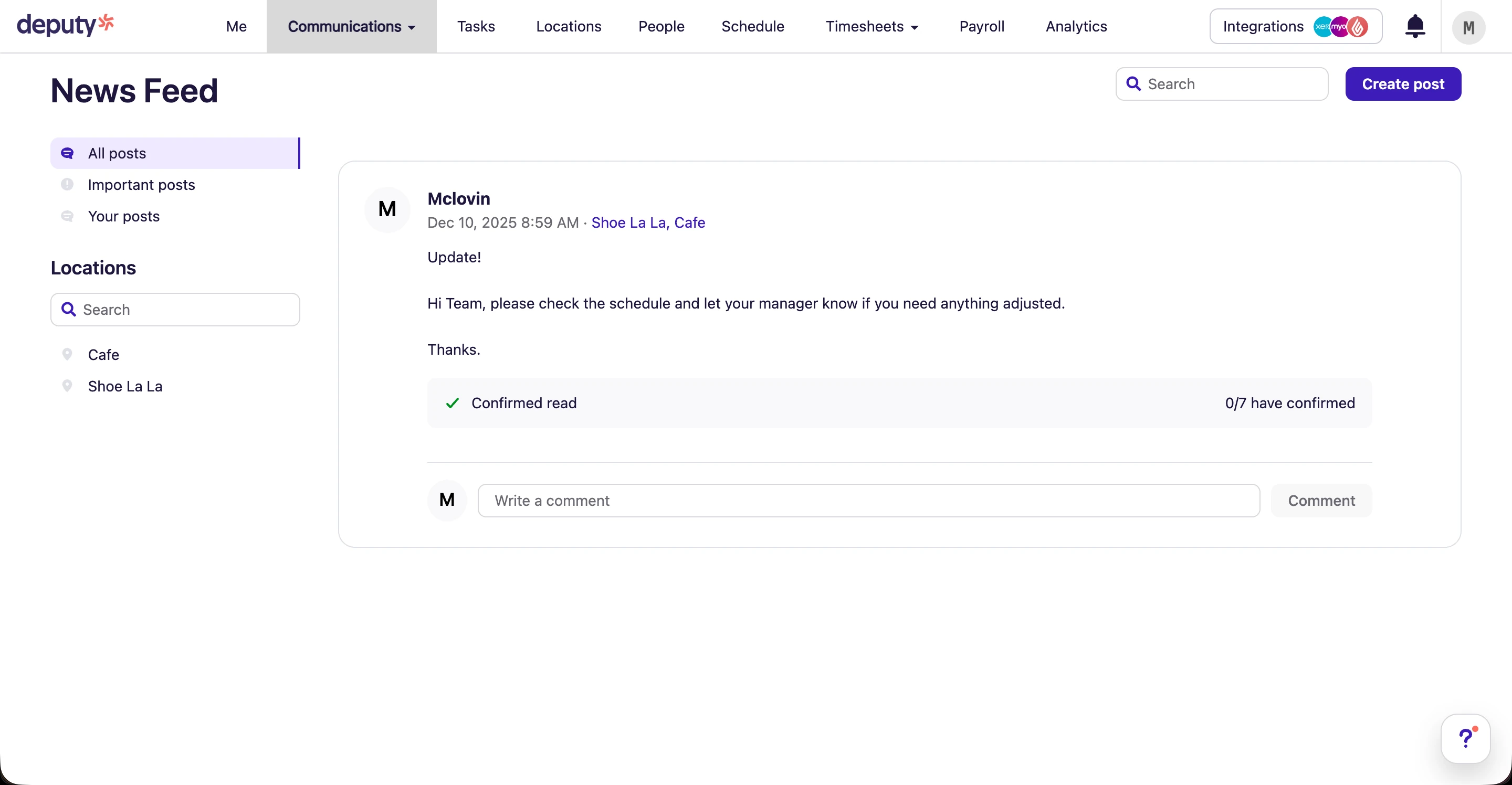
Deputy provides two core communication tools: Group Messages and a News Feed. The interface is clean, with filters that allow managers to sort chats by unread messages, direct messages, groups or archived threads. This level of filtering is not currently available in RosterElf.
Deputy also allows managers to view all members of a chat, access pinned messages and view shared media within a thread. These features give Deputy a clear advantage in message organisation, particularly for larger teams.
However, the platform shows noticeable lag when creating new chats. Creating a group chat requires waiting for staff lists to load, manually selecting each team member because there is no select all option, and then waiting through another loading step before the group is created. This slows down high-frequency communication and makes messaging less responsive for large organisations.
RosterElf offers an instant-messaging style chat system with a familiar interface similar to Deputy's, but with several usability improvements.
Key strengths include:
- Faster chat creation with near-instant performance
- Filtering options when creating groups such as site, position, selected staff or select all
- Clear separation between Group Chats and Direct Messages, reducing clutter often experienced in Deputy
- Chat descriptions that allow managers to provide context for ongoing threads, which Deputy does not offer
RosterElf also supports media sharing, emojis, notifications and muting options, giving teams a flexible communication tool without unnecessary complexity.
While RosterElf does not include pinned messages or media-specific search, its speed and simplicity make it well suited to shift-based teams that need fast and practical communication.

Notifications & operational messaging
Deputy includes basic messaging in its core plans, but the optional Messaging+ add-on (approximately $2.75 per user per month) unlocks additional functionality such as read receipts, scheduled messages, advanced notification controls and message delivery tracking.
For larger organisations that need communication oversight, compliance features or ways to audit staff engagement, Messaging+ may justify the additional cost. However, it does increase Deputy's overall pricing stack, especially when combined with other paid modules.

RosterElf includes all core messaging features without any add-on fees. This covers team messages, individual messages, location-based messages, roster change notifications, shift offer notifications, broadcast announcements and push notifications for approvals and updates.
Because messaging is included by default, SMEs do not face rising costs as communication needs increase, making it a more predictable and cost-efficient option for growing teams.

Real-world fit: operational differences
| Choose RosterElf if you… | Choose Deputy if you… |
|---|---|
| Want messaging included with no extra user fees | Need advanced features like read receipts or scheduled messages (Messaging+ add-on) |
| Need fast, instant communication (high volume messages, urgent updates, last-minute roster changes) | Want a dedicated News Feed for structured updates |
| Prefer simple chat creation with "select all", site, position or custom grouping | Prefer message filtering by unread, DM or group threads |
| Value a clean separation between group chats and direct messages | Operate in a larger organisation where communication tracking is essential |
| Need quick performance for multi-site or dynamic teams |
⭐ Verdict: RosterElf provides faster, included communication tools for SMEs, while Deputy offers more advanced messaging features through its Messaging+ add-on.
RosterElf is better for:
- All-included messaging with no extra fees
- Quick group creation and instant performance
Deputy is better for:
- Structured communications and pinned messages
- Audit-friendly message oversight
RosterElf vs Deputy: mobile app comparison
Mobile access is essential for shift-based teams, where staff and managers rely on their phones to check rosters, clock in, approve timesheets and communicate on the go. Both RosterElf and Deputy provide iOS and Android apps with core scheduling and attendance features — but the depth, speed and manager-level capabilities differ meaningfully between the two platforms.
Mobile app features deep dive
Core mobile capabilities
Deputy's mobile app provides the essentials most shift-based teams expect. Staff can view rosters, clock in and out with offline mode, send and receive messages, approve or edit timesheets, switch between multiple locations and manage tasks.
The app also integrates with Deputy's News Feed, allowing organisations to broadcast announcements directly to staff, which is particularly useful for larger teams. Multi-location switching is smooth and intuitive, making the app well suited to businesses that operate across several sites or venues.
However, Deputy's mobile app focuses primarily on operational basics rather than deeper management functionality. Managers cannot amend sites, positions or award settings from mobile, and some areas of navigation feel slower compared to RosterElf's more responsive interface.
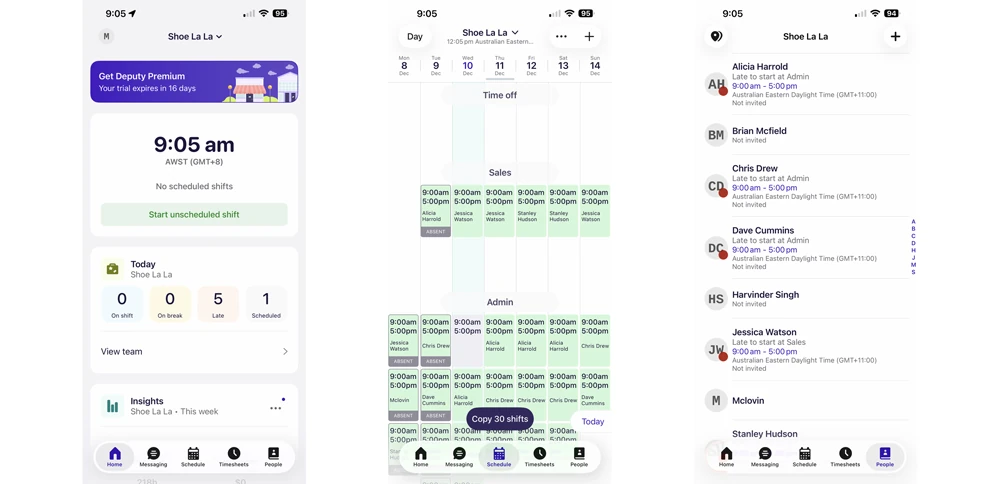
RosterElf's mobile app includes the same core functions staff expect, such as viewing rosters, clocking in and out with GPS and photo verification, requesting leave, managing availability and swapping shifts. It also extends further with several manager-level capabilities that are not available in Deputy's app.
Key manager tools include:
- Add or edit staff profiles
- Add or edit sites and positions
- Built-in WorkWise AI for Fair Work interpretation and guidance
- Direct in-app support for staff and managers
- A manager dashboard with insights, rostered hours and pay-rate trends
RosterElf's mobile app also delivers strong performance. Group creation, navigation and data loading are fast and responsive, giving managers a smoother experience when working on the go. The additional management tools make the app well suited to SMEs that need real-time decision making from anywhere.

Additional capabilities & performance
Deputy's mobile app offers several capabilities that stand out in specific operational environments. Offline clock-ins provide a reliable solution for sites with poor connectivity, ensuring staff can record time even without network access. Multi-location switching is smooth and intuitive, making it well suited to businesses that operate across multiple stores or venues. The inclusion of task management adds another layer of operational control, allowing managers to assign and track work directly from the app. Deputy's integration with the News Feed also supports structured company-wide announcements, giving larger organisations a centralised way to communicate updates to staff.

RosterElf offers several mobile capabilities that provide managers with greater control while on the go. The ability to amend sites and positions directly from the mobile app gives managers flexibility that Deputy does not currently support. Full staff management tools are available, allowing updates to staff profiles, employment details and permissions without needing to switch to desktop.
Built-in AI assistance through WorkWise provides guidance on compliance and Fair Work requirements, helping managers make informed decisions in real time. The app also delivers faster chat creation and smoother navigation, improving day-to-day communication across teams. In-app support is available for both managers and employees, ensuring questions or issues can be resolved quickly. The manager insights dashboard presents visual trends for rostered hours and pay-rate patterns, making it easier to stay across operational performance from anywhere.

Real-world fit: operational differences
| Choose RosterElf if you… | Choose Deputy if you… |
|---|---|
| Are a small or mid-sized business needing fast, simple mobile workflows | Operate large, multi-location businesses needing smooth location switching |
| Want deeper manager functionality directly inside the app | Require News Feed–style communication alongside messaging |
| Need to modify sites, positions or staff settings on the go | Need offline clock-ins in low-connectivity environments |
| Value AI-powered support for compliance | Use Deputy's broader ecosystem (tasks, enterprise-level modules) |
| Prefer a lightweight, responsive mobile experience without add-ons |
⭐ Verdict: RosterElf delivers a stronger mobile experience for managers, while Deputy excels in multi-location support and offline clock-ins.
RosterElf is better for:
- Editing sites, positions, and staff on mobile
- AI HR guidance and fast navigation
Deputy is better for:
- Offline clock-ins
- Large teams needing smooth location switching
RosterElf vs Deputy: HR tools comparison
Modern workforce platforms increasingly include HR features that extend beyond rostering and timesheets. While neither RosterElf nor Deputy aims to replace a full HRIS, both provide HR tools designed to simplify onboarding, document handling and employee compliance. The depth, pricing and usability of these HR features, however, differ significantly.
HR features deep dive
Scope of HR features & pricing
Deputy's HR capabilities sit inside the People tab and include new hire onboarding, a document library, team document storage, hiring tools such as job ads, interview workflows and a careers page, as well as team engagement tracking. These features give Deputy a broad HR footprint that extends beyond basic compliance and record keeping.
The HR add-on is priced at $3.50 per user per month, with a slight discount on annual plans, making it the more expensive option when compared with RosterElf's HR Hub.
Deputy's HR module is feature-rich, particularly in the areas of recruitment and candidate management, but setup complexity and limited on-screen guidance are common friction points. Businesses may find that additional onboarding support is needed to configure and maintain these tools effectively.

RosterElf's HR Hub is included in the Full Suite plan at $10 per employee/month (or $7 with annual billing), giving SMEs immediate value without adding to their software stack.
The HR Hub is a well-rounded and intuitive module that focuses on the essential HR functions small and medium businesses need. It includes employee onboarding, fully customisable digital contracts, an editable policies and procedures library, centralised document storage and qualification or certification tracking with automatic expiry alerts.
RosterElf prioritises simplicity and compliance for SME environments, making it easy for businesses to manage core HR requirements without purchasing additional HR systems or navigating complex setup processes.

Onboarding experience
Deputy's onboarding workflow requires managers to navigate to the onboarding menu, manually enter employee details because there is no bulk import option, and configure superannuation and other onboarding items. The interface contains several small, clickable menus without clear explanations, which can create confusion during the setup process.
Deputy's onboarding system functions reliably, but it is not highly automated and can feel unintuitive. This results in more manual work for businesses that onboard staff at scale or need a faster way to bring new employees into the system.

RosterElf's onboarding is more direct, with fewer menus and clearer steps. Staff can receive digital contracts and policy documents automatically, with tracked acknowledgements and integrated qualification requirements.
Where Deputy offers breadth, RosterElf provides clarity + simplicity, making it particularly strong for SMEs that need onboarding to be fast, repeatable and compliant without an HR specialist involved.

Documents & policies
Deputy's document system requires businesses to upload their own HR documents. There is no template library, no ability to customise documents within the platform and only a simple toggle to require staff acknowledgement.
For a paid add-on at $3.50 per user per month, this part of the module feels limited in capability, especially when compared with Deputy's more polished hiring features.

RosterElf supports fully customisable employment contracts, an editable policy library, automated document delivery with tracked acknowledgements and role-specific document assignments. These tools give SMEs a complete, flexible way to manage HR documentation without relying on external systems or manual workflows.
RosterElf delivers more functionality at a lower cost, and the value increases further for customers on annual plans where the HR Hub is included at no additional charge.

Hiring & applicant tracking
Deputy provides a comprehensive recruitment module that includes customisable job listings, applicant tracking, interview management tools and a fully customisable careers page. It also integrates with major job platforms such as Indeed, LinkedIn, Jora, Adzuna and others, enabling businesses to publish roles and manage applications from a central location.
This recruitment functionality is significantly more advanced than RosterElf's current offering, making Deputy a stronger choice for businesses with high turnover, frequent hiring needs or structured recruitment workflows.

RosterElf is developing its own hiring tools but does not yet match Deputy's recruitment depth. Until released, RosterElf's HR Hub is best viewed as HR management, not HR acquisition.
Real-world fit: operational differences
| Choose RosterElf if you… | Choose Deputy if you… |
|---|---|
| Want affordable, integrated HR for small to medium teams | Need recruitment features (job ads, interviews, applicants, careers page) |
| Use digital contracts, policies and qualification checks regularly | Want performance or engagement tracking tools |
| Prefer simple, automated onboarding over complex workflows | Prefer deeper HR functionality and do not mind higher cost |
| Are on an annual plan (HR Hub included free) | Have HR specialists comfortable navigating multi-layered menus |
| Don't require advanced recruitment tools |
⭐ Verdict: RosterElf offers simpler, more cost-effective HR tools for SMEs, while Deputy provides broader HR capabilities, especially in recruitment.
RosterElf is better for:
- Digital contracts, policies, and qualifications
- Fast onboarding without setup complexity
Deputy is better for:
- Job ads, applicant tracking, and careers pages
- Organisations with structured recruitment workflows
RosterElf vs Deputy: reporting comparison
Both RosterElf and Deputy offer reporting tools that surface labour, attendance and workforce insights — but they take noticeably different approaches in design, depth and usability.
Data-driven insights help businesses improve labour costs and workforce planning. Both platforms offer reporting capabilities with different levels of depth.
RosterElf includes built-in analytics covering labour costs, roster efficiency, attendance patterns and payroll summaries. Reports can be filtered by location, team or date range, and exported for further analysis. These features are included in the core plan.
Deputy provides standard reporting in its core plans, with advanced analytics available through the Analytics+ add-on ($2 per user/month). The add-on includes custom dashboards, trend analysis, labour cost forecasting and benchmarking tools for multi-location operations.
RosterElf's included analytics meet the needs of most SMEs. Deputy's Analytics+ suits larger organisations requiring sophisticated forecasting and cross-location comparisons, though at additional cost.
| Feature area | RosterElf | Deputy |
|---|---|---|
| Report navigation | All reports on one page with short descriptions | Reports split across landing page + "View All Reports" list |
| Report descriptions | Clear, brief explanations for each report | Minimal descriptions; some reports unclear (e.g., "Kudos Report") |
| Custom reporting | ❌ Not available | ✅ Highly customisable report builder |
| Ease of Use | Very accessible for new users | Steeper learning curve |
| Export options | PDF / CSV | PDF / CSV / Email / Webhook / More |
| Filtering | Strong presets (staff, site, role, date ranges) | More manual filtering |
| Favouriting reports | ✅ Yes | ❌ No |
| Best for | SMEs wanting simple, ready-to-use reports | Advanced users needing deep customisation |
⭐ Verdict: RosterElf provides easy, ready-to-use analytics for SMEs, while Deputy's Analytics+ offers deeper custom reporting for larger organisations.
RosterElf is better for:
- Simple operational reporting
- One-page, accessible report navigation
Deputy is better for:
- Custom dashboards and multi-location reporting
- Advanced labour forecasting
Best fit & use cases
RosterElf and Deputy suit different types of organisations, so understanding where each platform performs best helps clarify which tool is the better fit for your team.
| Use case / fit | RosterElf | Deputy |
|---|---|---|
| Best for business size | Small–medium Australian businesses | Medium–large organisations; enterprises |
| Best for industry | Hospitality, retail, healthcare, NDIS, childcare | Multi-site retail, franchises, large hospitality groups |
| Workforce complexity | Simple to moderate rostering | Complex, multi-location scheduling models |
| Compliance fit | Australian Fair Work + Xero/MYOB ecosystem | Global labour compliance + multi-region templates |
| Operational footprint | Primarily AU/NZ teams | Global, international teams |
| Feature depth | Easy-to-use, simplified | Deep feature stack, forecasting, modelling |
| Onboarding style | Fast adoption, low-overhead setup | More configuration, suited to larger rollouts |
| Cost efficiency | High (single plan + simple pricing) | Higher TCO for equivalent functionality |
RosterElf is best for
- Australian shift-based SMEs: RosterElf is purpose-built for Australian businesses with built-in Fair Work award interpretation and strong Xero/MYOB integrations.
- Hospitality, retail and healthcare teams: Drag-and-drop rostering, mobile time clock, and payroll-prep features are designed for these industries.
Deputy is best for
- Large multi-location enterprises: Deputy's AI-powered forecasting and tiered feature access suit organisations with complex scheduling needs across many sites.
- International teams: With global coverage and compliance templates for multiple jurisdictions, Deputy works well for businesses operating across borders.
Use cases deep dive
RosterElf is most naturally suited to Australian shift-based SMEs that want straightforward rostering, strong payroll integrations, and Australian award interpretation without enterprise-grade complexity. Its clean interface, fast setup, and predictable pricing make it ideal for teams that value ease of use and minimal administrative overhead.
Deputy, by contrast, is designed to support organisations operating across multiple locations or countries. Its AI forecasting, labour-modelling tools, and granular configuration options become more valuable as workforce complexity grows. For larger retail groups, franchises, or companies with multi-region compliance needs, Deputy's global infrastructure and enterprise maturity provide advantages that extend beyond standard rostering.
Both platforms are strong, but they excel in different contexts — RosterElf for clarity and simplicity, Deputy for scale and organisational complexity.
⭐ Verdict: Choose RosterElf for simplicity and Australian compliance; choose Deputy for scale and complexity.
RosterElf delivers the best fit for Australian SMEs that want fast adoption, Fair Work award interpretation, and seamless Xero/MYOB payroll workflows at a predictable price point. It's improved for small to mid-sized teams that prioritise ease of use, operational efficiency, and local support.
Deputy is the stronger match for larger or multi-location organisations that need advanced forecasting, labour modelling, and global compliance coverage. Its broader feature depth and enterprise infrastructure suit companies managing complex schedules across multiple regions.
User ratings (independent & non-incentivised sources only)
To ensure a fair and transparent comparison, this evaluation focuses only on non-incentivised, publicly verifiable review sources.
Platforms like Capterra and G2 were intentionally excluded due to the prevalence of paid review programmes.
The two most reliable sources for Australian workforce management software are:
- Google Reviews — public, unfiltered, and widely trusted
- Xero App Store Reviews — verified by real businesses using payroll integrations
Below is how RosterElf and Deputy compare across these independent channels.
Google reviews
Deputy — Google reviews
Deputy does not maintain a public Google Business Review page, making it impossible to compare customer satisfaction on the same footing as RosterElf.
While not unusual for global SaaS platforms, this absence limits transparency and removes an important public feedback channel.
RosterElf — Google reviews (4.7/5, 180 reviews)
RosterElf maintains an active Google Business profile with consistently positive feedback.
Recent reviews highlight:
- Ease of use & quick learning curve
- Exceptional support (multiple mentions of named team members)
- Clear payroll improvements
- Reliable rostering and onboarding experience
Example recent Google feedback:

"Really detailed and helpful… First time user of a rostering software."
"Extremely happy… a great improvement on the previous system we were using."
"Completely transformed the way I manage my business."
"The best user-friendly system I have used."
"Integrates well with Xero. Exactly what we needed."
Across more than 30 recent reviews, RosterElf consistently receives praise for:
- Australian-based, responsive support
- Simplicity for new users
- Payroll accuracy & Xero integration
- Helpful onboarding guidance
Xero app store reviews
Because both platforms integrate with payroll systems, the Xero App Store provides the most reliable like-for-like comparison.
Deputy — Xero App Store rating: 3.9/5 (147 reviews)
Feedback is mixed, with praise for feature depth but recurring concerns about:
- Xero integration issues
- Support delays
- Complex setup for payroll and awards
Examples:

"Integration is impossible… waiting on customer service."
"Not good. Integration with Xero never worked… waste of time and money."
"Serves the purpose… but lacks customisation."
"Deputy simplifies our payroll… big time saver."
Deputy performs well for businesses with large teams and structured processes, but SMEs frequently cite:
- Complexity
- Integration instability
- Slow or inconsistent support
RosterElf — Xero App Store rating: 4.9/5 (93 reviews)
RosterElf's Xero integration receives exceptionally strong feedback, with consistently high ratings and commentary emphasising:
- Accurate award interpretation
- Seamless payroll exports
- Excellent customer service
Examples:
"Excellent app… simple and easy to use."
"Always excellent customer service… super patient and helpful."
"Great support… helpful bringing our business onboard."
"Very intuitive and easy to use… responsive staff."
"Award interpretation is spot-on… removed so many payroll errors."
Xero reviewers consistently highlight:
- Fast setup
- Reliable payroll accuracy
- Support that goes beyond the basics
- Ease of use for non-technical managers
Independent review summary
| Review source | RosterElf | Deputy |
|---|---|---|
| Google reviews | 4.7 / 5 | ❌ No public review page |
| Xero App Store | 4.9 / 5 | 3.9 / 5 |
What the independent data shows
RosterElf outperforms Deputy in:
- Ease of use
- Payroll accuracy
- Xero integration
- Support responsiveness
- Customer satisfaction consistency
Deputy's reviews show strong capability but recurring themes of:
- Higher complexity
- Integration challenges
- Slower support paths
- More variable customer experience
⭐ Verdict: RosterElf delivers stronger user satisfaction across independent review platforms
Since Deputy does not maintain a public Google Review presence, the Xero App Store becomes the fairest like-for-like source, and RosterElf holds a significantly higher rating.
Across all available independent review channels, RosterElf presents:
- Higher ratings
- More consistent positive feedback
- Stronger support sentiment
- Fewer integration-related complaints
For Australian SMEs choosing between the two, user ratings strongly favour RosterElf as the more reliable, easier, and better-supported option.
Security & privacy
Both platforms store sensitive employee data, so security is non-negotiable. Here's how they compare.
Security features compared
| Feature | RosterElf | Deputy |
|---|---|---|
| Data encryption (at rest + in transit) | ✅ Yes | ✅ Yes |
| PII Encryption | ✅ Documented | Not explicitly stated |
| Role-based access controls | ✅ Yes | ✅ Yes |
| Two-factor authentication (2FA) | ✅ Yes | ✅ Yes |
| SSO (Single Sign-On) | ❌ No | ✅ Yes (Enterprise) |
| GDPR compliant | ✅ Yes | ✅ Yes |
| Australian data hosting | ✅ Yes | ✅ Yes |
| SOC 2 Type II certified | ❌ No | ✅ Yes |
| Redundancy & restore | ✅ Documented | Not explicitly stated |
| Audit logs | Basic | ✅ Yes |
Security and privacy deep dive
RosterElf is transparent about PII encryption at rest and redundancy/restore capabilities, while Deputy doesn't explicitly document these on its public-facing security pages. Deputy, however, holds SOC 2 Type II certification—a third-party attestation that RosterElf currently lacks. For Australian SMEs without enterprise compliance mandates, RosterElf's documented security posture is generally sufficient. Larger organisations or those in regulated industries may lean towards Deputy's SOC 2 certification.
⭐ Verdict: Deputy offers stronger enterprise security features (SSO, SOC 2). RosterElf covers the essentials well for SME needs with better documentation on PII and redundancy.
Customer support
Support quality matters, especially when you're mid-shift and something breaks. Here's how each platform handles it.
Support channels compared
| Support Type | RosterElf | Deputy |
|---|---|---|
| Phone support | ✅ Yes (Australian hours) | ✅ Yes (Enterprise only) |
| AI Live Chat | ✅ Yes (Elf AI) | ✅ Yes |
| AI chatbot | ✅ Yes | ❌ No (traditional chatbot only) |
| Email support | ✅ Yes | ✅ Yes |
| Knowledge base | ✅ Yes | ✅ Yes |
| Video tutorials | ✅ Yes | ✅ Yes |
| Onboarding assistance | ✅ Yes (included) | ✅ Yes (varies by plan) |
| Dedicated account manager | ❌ No | ✅ Yes (Enterprise) |
| Australian-based support | ✅ Yes | Partial (global team) |
| SLAs | Not publicly documented | Enterprise plans |
Support experience
RosterElf support is Australian-based and accessible via phone, email and live chat during business hours. The team is known for being responsive and hands-on, which suits SMEs that want quick answers without navigating enterprise-tier support queues. RosterElf also offers Elf AI, an AI-powered assistant embedded in the platform for self-service queries.
Deputy's support scales with plan tier. Lite and Core users rely primarily on chat and email, while Enterprise customers unlock phone support and dedicated account managers. Deputy's global support team provides coverage across time zones, but Australian businesses may occasionally interact with offshore agents.
⭐ Verdict: RosterElf offers more accessible, local support. Deputy's premium support is gated behind Enterprise plans.
RosterElf is better for:
- Businesses wanting phone support without enterprise pricing
- Australian businesses preferring local, same-timezone help
Deputy is better for:
- Large enterprises needing dedicated account managers
- Global teams needing 24/7 coverage
Final verdict: Deputy vs RosterElf
After testing both platforms extensively, here's the bottom line.
Category winners at a glance
| Category | Winner | Why |
|---|---|---|
| Pricing & value | 🏆 RosterElf | Lower base price, more features included, no hidden add-ons |
| Rostering & scheduling | 🏆 RosterElf | Simpler, faster day-to-day rostering with award-aware tools |
| Time & attendance | 🏆 RosterElf | Custom geo-pin accuracy, required notes for early/late clock-ins |
| Timesheets & payroll | 🏆 RosterElf | Faster payroll-prep workflow, deeper Xero/MYOB integration |
| Communication | 🏆 RosterElf | Messaging included free, no add-on fees required |
| Smartphone apps | 🏆 RosterElf | Stronger mobile experience for managers, more editing capabilities |
| HR tools | 🏆 RosterElf | HR Hub is cheaper, includes contracts, policies, onboarding |
| Analytics & reporting | 🏆 RosterElf | Ready-to-use analytics included, no add-on required |
| User ratings | 🏆 RosterElf | Higher ratings on Xero App Store (4.9 vs 3.9) and Google |
| Customer support | 🏆 RosterElf | Phone support included, Australian team, faster response times |
| Security & privacy | 🏆 Deputy | SOC 2 Type II, SSO, enterprise-grade security features |
| Best fit & use cases | Depends | RosterElf for SMEs; Deputy for large/complex organisations |
🏆 Overall Winner: RosterElf (for Australian SMEs)
RosterElf wins on award compliance, pricing transparency, and local support. It's purpose-built for Australian businesses that need rostering, time tracking, payroll, and HR to just work, without spending hours on configuration.
 Recommended for SMEs
 Choose RosterElf if you:
- Operate under Australian Modern Awards
- Have 5–150 employees
- Want automated penalty rate calculations
- Use Xero or MYOB for payroll
- Prefer simple, fast implementation
- Value responsive, Australian-based support
Enterprise focus Choose Deputy if you:
- Operate across multiple countries
- Have 200+ employees or complex enterprise needs
- Need demand forecasting or advanced analytics
- Already use ADP, Gusto, or a large HRIS
- Require SSO and SOC 2 compliance
Review methodology
Our review methodology
Learn how we evaluate workforce management platforms through hands-on testing and verified user feedback.
Feature comparisons are checked against each vendor's public documentation at the time of writing. Assessments of usability, fit and value are our reviewers' opinions, not statements of fact, and products change often. We'd encourage you to trial both platforms and judge for yourself. Spotted something out of date? Tell us and we'll correct it .
Related resources
Start your free 15-day RosterElf trial today
Join 30,000+ Australian workplaces using RosterElf to simplify rostering, payroll and HR.
Deputy vs RosterElf FAQ
- We run the same head-to-head against every major platform: Tanda vs RosterElf, Connecteam vs RosterElf and Employment Hero vs RosterElf. For a five-way view of the whole category, start with best rostering software in Australia.
- The answer depends on your business needs. Deputy is a robust platform suited for larger teams with complex forecasting needs, though it requires multiple add-ons for full functionality. RosterElf is designed specifically for Australian SMBs with built-in award interpretation, simpler all-in-one pricing, and dedicated local support. If you need award compliance without manual configuration, RosterElf is typically the better choice.
- Deputy's base Core plan starts at $8.75 per user per month. Adding HR, messaging, analytics and payroll separately comes to $22.00, or $13.95 on Deputy's All-in-One Bundle. RosterElf offers transparent all-in-one pricing with award interpretation, rostering, time tracking, payroll integration, HR, and team communication built-in. Compare total feature costs rather than headline prices to find the best value.
- RosterElf includes built-in award interpretation that automatically calculates penalty rates, allowances, and overtime according to modern awards. Deputy requires manual setup of award templates and places responsibility on managers to configure rules correctly, which can lead to compliance errors. For Australian award compliance, RosterElf's automated approach is significantly easier and more reliable.
- Yes, switching from Deputy to RosterElf is straightforward. You can export your employee data from Deputy and import it into RosterElf via CSV. Our team provides free onboarding assistance to help configure your rosters, awards, and integrations. Check our Deputy alternative guide for step-by-step switching instructions and migration tips.
- Both platforms integrate with Xero, but user feedback suggests RosterElf's integration is more seamless for Australian businesses. RosterElf automatically maps award-interpreted pay items to Xero, reducing manual adjustments. Deputy users sometimes report integration complexity and issues with award rate mapping. If seamless Xero payroll is critical, test both platforms during your trial period.
- Yes, both Deputy and RosterElf offer comprehensive mobile time clock features including GPS tracking, photo verification, and geofencing. Staff can clock in/out from their smartphones, and managers receive real-time notifications. Deputy includes facial recognition on some plans, while RosterElf uses photo capture for buddy punching prevention. Both approaches are effective for Australian businesses. The main difference is that RosterElf's time clock data automatically feeds into award-interpreted timesheets ready for payroll.
- Both platforms work well for hospitality, but RosterElf is specifically designed with Australian hospitality in mind. It includes pre-configured templates for the Hospitality Industry (General) Award with automatic penalty rates for weekends, public holidays, and split shifts. RosterElf also integrates with popular POS systems used in Australian hospitality. Deputy offers stronger demand forecasting based on sales data, which benefits larger hospitality chains. For independent restaurants, cafes, and small hospitality groups, RosterElf provides better value and simpler setup.
- Users switch from Deputy to RosterElf primarily for pricing clarity, rostering usability, and award interpretation simplicity. In head-to-head testing, RosterElf wins 10 of 11 comparison categories. On pricing: Deputy Core at $8.75/employee/month reaches approximately $22.00/month once you add HR, messaging, analytics, and payroll modules — RosterElf includes all of these in its all-in-one plan at $8/month, saving most businesses over 50%. On rostering: RosterElf displays more shift detail on-screen, includes inline filtering and live labour cost visibility directly inside the roster, and offers a fortnightly and monthly view Deputy does not. On payroll: RosterElf's award interpretation is significantly more accessible — reviewers configured a full pay run in RosterElf in the same time it took to attempt a single award setup in Deputy. Users also rate RosterElf's Xero integration higher and find support faster to reach. Deputy is the better choice for organisations needing advanced AI auto-scheduling, demand forecasting, or enterprise-scale workforce features.