


Deputy vs Employment Hero Which is better for Australian businesses?
Comparing Deputy vs Employment Hero? Both help Australian businesses manage staff, but Deputy focuses on shift-based workforce management while Employment Hero offers broader HR and payroll functionality. Here's how they compare on rostering, Australian awards, payroll and pricing.
- Both sell rostering, HR and payroll
- Deputy: rostering on every plan
- Employment Hero: rostering is a $5 add-on

 Written by Steve Harris·Edited by Georgia Morgan · 12 min read
This comparison draws on RosterElf's own hands-on research (trial accounts, December 2025), Australian pricing checked 10 Nov 2026 and each vendor's published features. We say which workflows we saw directly and which come from vendor documentation. RosterElf publishes this page and offers competing software. Sources and method.
Deputy vs Employment Hero at a glance
How the two differ before the detail. Prices read 10 Nov 2026, in AUD, ex GST.
From each vendor's own pages (see sources). "Depends on plan" means the feature is on some plans or tiers only; "Not verified" means neither its pages nor our trial showed it. Full plan matrices: Deputy review and Employment Hero pricing.
Which platform fits your business?
If managers build rosters every week, adjust shifts and approve timesheets across sites, Deputy may be the more natural start. If recruitment, HR documents, development and payroll administration carry more weight, Employment Hero may fit better. Four questions settle it.
Which modern awards, classifications and enterprise agreements apply to you matters more than either feature list. Take them to both demos.
Still considering your options?
Deputy vs Employment Hero pricing in Australia
They bundle differently, so a lower headline price does not mean a lower total. Pick what you need and your team size. Deputy and Employment Hero only, from their published prices.
At 20 staff, these published prices make Deputy billed monthly $125 a month lower. Check what each line includes before reading much into it.
Not a like-for-like pair: Employment Hero sells rostering only as an add-on to a plan, so its line includes HR Essentials ($11 per user), which brings HR features Deputy Core does not have.
Worked examples at 10, 20 and 50 staff
| Setup and staff | Deputy monthly | Deputy annual | Employment Hero |
|---|---|---|---|
| Rostering and time only, 10 staff
| $98 | $88 | $160 |
| Rostering and time only, 20 staff
| $195 | $175 | $320 |
| Rostering and time only, 50 staff
| $488 | $438 | $800 |
| Rostering + native payroll, 10 staff
| $148 | $133 | $150 |
| Rostering + native payroll, 20 staff
| $295 | $265 | $300 |
| Rostering + native payroll, 50 staff
| $738 | $663 | $750 |
| Rostering + HR + payroll, 10 staff
| $155 | $140 | $260 |
| Rostering + HR + payroll, 20 staff
| $310 | $279 | $520 |
| Rostering + HR + payroll, 50 staff
| $775 | $698 | $1,300 |
- Monthly figures in AUD, ex GST, read 10 Nov 2026. Deputy, per user a month: Lite $7.50, Core $9.75, Pro $14.50 and the All-in-One bundle $15.50 billed monthly, or $6.75, $8.75, $13 and $13.95 on an annual plan (billed upfront or in monthly instalments). Add-ons: Payroll $5 and HR $3.50 billed monthly, 10% less on annual. Monthly Lite, Core and Pro plans have a minimum spend of $30 per invoice. Deputy is advertising three months free on annual All-in-One until 31 December; the calculator leaves that out.
- Employment Hero: Payroll $10, HR Essentials $11 and HR Engage $15 per user, with a minimum of 10 users on every plan; the rostering add-on is $5 per employee a month (minimum $50). Its pricing page states no billing period beside plan prices; its General Terms say fees exclude GST and subscriptions renew month to month, so we treat them as monthly. HR Elite and Employment Unlimited are quote-only.
- Onboarding fees, implementation and any negotiated discounts are not included for either vendor.
Full plan detail: Deputy pricing and Employment Hero pricing.
Also considering RosterElf?
RosterElf Full Suite for 20 active employees: $200 a month billed monthly, or $140 a month on annual billing, ex GST.
RosterElf publishes this comparison. Full Suite includes different features from the Deputy and Employment Hero setups above, and payroll stays in Xero or MYOB. See RosterElf pricing
Rostering and time and attendance compared
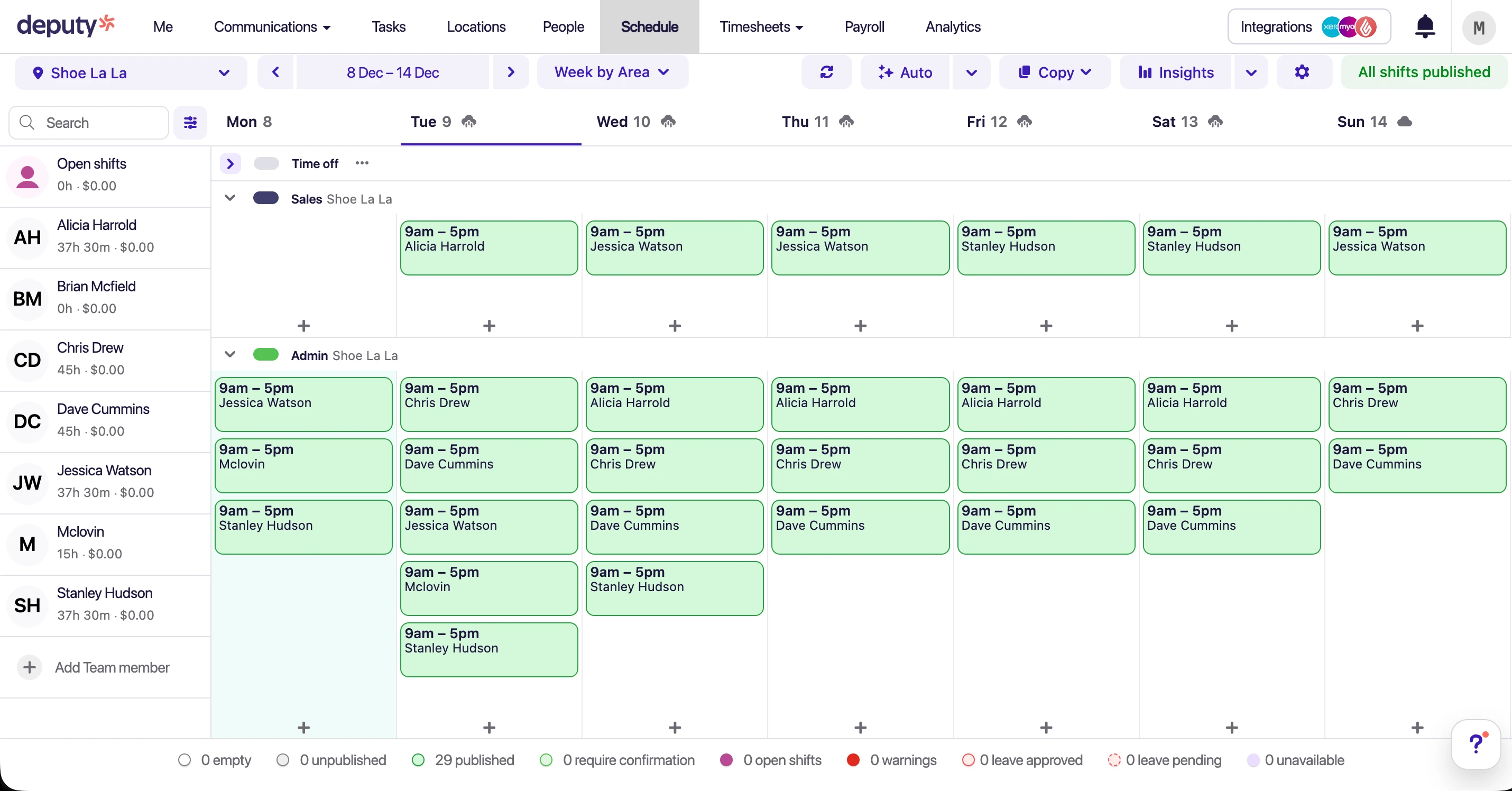
Deputy is built around scheduling frontline teams. Employment Hero added rostering to an HR and payroll platform, which suits teams that want those connected.
Deputy
- Rostering, timesheets and time clocking on every plan; Core adds advanced rostering and timesheet auto-approval
- Auto-build and AI rostering: type or say what you need and review the changes before they go out
- Wage costing while you roster, with labour budgets and demand forecasting on higher plans
- Biometric time clocking from Core
Employment Hero
- Rosters, shift bidding and swaps in the Rostering & Time and Attendance add-on
- Time clocks, timesheets and geofencing in the same add-on
- Labour costs monitored in real time, with award-based costing
- Connected to Employment Hero HR and payroll if you use them
Deputy
Employment Hero

Deputy

Employment Hero

What to test in both trials
- Build a repeating weekly roster for one site, then copy it forward.
- Fill an open shift and handle a last-minute swap.
- See what the roster costs, with penalty rates, before you publish it.
- Deal with a missed clock-in, then approve the week’s hours for payroll.
Rostering verdict: Deputy is particularly attractive where day-to-day scheduling is the main operational job. Employment Hero may be attractive where scheduling sits inside a broader people-management workflow. The better one is whichever completes your real roster reliably.
Australian award interpretation and compliance
Award rules change penalty rates, overtime, allowances, minimum engagement and labour costs. What matters is what your plan includes and how the result reaches payroll.
Deputy
- Award interpretation on Lite; advanced award interpretation on Core
- Award templates (for example General Retail and Hospitality), which Deputy says it reviews as Fair Work rules change
- Pay Rate Builder for overtime adjustments, premiums and shift allowances
- Award entitlements and timesheets sync to Deputy Payroll or your payroll software
Employment Hero
- Award-based costing in the rostering add-on, so shift costs reflect award rates
- Award interpretation for pay runs in its Payroll plan ($10 per user, 10-user minimum), not in the HR plans
- Award rules, rosters and pay in one platform if you take both
Ask each vendor which awards and classifications it supports, how custom rules and enterprise agreements are configured, and how results transfer to payroll. Whichever you choose, the employer stays responsible for correct classification, rate setup and pay.
Example: test a Sunday hospitality shift in both
Take one real shift to both demos, say a casual food and beverage attendant working Sunday from 4pm to midnight under the Hospitality Industry (General) Award, and check each of these. It is an illustration of what to test, not a result from either product.
- Classification and employment type: is the casual loading applied on top of the right level?
- Weekend penalties: does Sunday pay at the Sunday rate, and a public holiday at its own rate?
- Evening and late work: does the late-work loading start at the time your award sets?
- Overtime: does it start after the daily or weekly ordinary hours in your award, not a generic 38?
- Allowances: can you add one (a split shift or uniform allowance, say) and see it on the timesheet?
- Into payroll: do the approved hours arrive in payroll with each penalty as its own pay item?
Verdict: neither wins this because a checklist says "award interpretation". Ask for a demo of your own award and shift scenarios, such as a Sunday shift, overtime and an allowance.
Payroll and Xero integrations
Both now run Australian payroll.
This is no longer "Deputy integrates with payroll, Employment Hero runs it". Deputy has its own payroll product as well as integrations, and Employment Hero has payroll plans and a managed service.
Deputy
- Deputy Payroll: timesheets to pay in one step, multi-entity pay runs and payslips in the app
- Designed to support Single Touch Payroll Phase 2, per Deputy
- $5 per user a month as an add-on, or in the All-in-One bundle
- Also exports to other payroll systems; listed on the Xero App Store
Employment Hero
- Payroll plan: unlimited pay runs, automated tax, award interpretation, payroll reporting
- Native link to Employment Hero HR
- Managed Payroll with a dedicated specialist, $21 per employee a month (minimum $420)
- Listed on the Xero App Store
For either one, confirm pay-run setup, STP reporting, award calculations, approvals, leave balances, accounting integration and cost. If you use Xero or MYOB, check the exact product and which data flows each way rather than assuming every integration behaves the same.
Verdict: choose on the whole scheduling-to-payroll process and the finance systems you already run, not on one integration rating.
HR, onboarding and employee management
Employment Hero has the wider HR suite. Deputy has HR too, sold as an add-on, so it should not be described as lacking HR.
Deputy HR ($3.50 per user a month, or in the bundle)
- Hiring: job ads posted to boards such as SEEK and Indeed, and applicant tracking
- Paperless onboarding and document management
- Performance management, staff feedback surveys and HR reporting
Employment Hero HR plans
- HR Essentials ($11): employee records, leave, documents, onboarding and offboarding, policies
- HR Engage ($15): adds recruitment, expenses, performance reviews, 1:1s and learning
- HR Elite: advanced automation, reporting and security, quote-only
If extensive recruitment or people development matters, Employment Hero deserves close attention. If your HR needs are tied to shift-based operations, Deputy may give you a practical mix of rostering, time tracking and HR.
Employee apps, communication and support
Both apps let staff check rosters, set availability, record time and see their details. Employment Hero's leans to wider HR self-service; Deputy's is built around frontline tasks.
Deputy
- App for shifts, swaps, clocking in, leave and payslips
- Messaging+ add-on ($2.75 per user a month) for shift-aware team messaging
- Support: "24/7 help and support", per its pricing page; priority support on Pro
Employment Hero
- Employment Hero Work app for rosters, leave, payslips and HR self-service
- Chat add-on ($2.50 per employee a month, minimum $25) for team messaging
- Support: help centre and chat on HR Essentials; priority support in Employment Unlimited
Review-site ratings
| Overall star rating | Deputy | Employment Hero |
|---|---|---|
| Xero App Store (AU) Businesses using the Xero connection | 3.9 / 5 (148 reviews) | 3.2 / 5 (20 reviews) |
| Capterra AU Verified reviewers; some reviews are incentivised | 4.6 / 5 (775 reviews) | 4.4 / 5 (239 reviews) |
| G2 Business users worldwide | 4.5 / 5 (943 reviews) | 4.4 / 5 (4,538 reviews) |
| G2 category score (out of 10) | Deputy | Employment Hero |
|---|---|---|
| Ease of setup | 9.1 (637 responses) | 7.8 (671 responses) |
| Ease of use | 9.1 (747 responses) | 8.8 (3,097 responses) |
| Quality of support | 8.8 (624 responses) | 8.0 (721 responses) |
All read 8 Nov 2026, except Employment Hero's Xero App Store rating (6 Nov 2026). Only 6 of Employment Hero's 20 Xero reviews are visible, so treat it as a small sample. G2 scores come from its Deputy vs Employment Hero page and include reviewers outside Australia. Ratings add context; they do not prove one product is more reliable. Support channels and hours change, so confirm them with each vendor. For what Employment Hero customers report, see why customers leave Employment Hero.
Which is better for your industry?
Choose on the workflows you need, not company size alone.
Hospitality
Compare variable rosters, penalty rates, break handling and how each fills a last-minute gap.
Retail
Compare multi-site scheduling, labour budgets against trading hours, and staff availability.
Healthcare and aged care
Check qualifications on shifts, coverage rules, classifications, approvals and payroll rules.
Final verdict: Deputy or Employment Hero?
Deputy
A strong option where the daily priority is rostering and managing frontline labour. Its scheduling focus, attendance tools and Australian payroll are particularly relevant to shift-based operations.
Employment Hero
A strong option for broader HR management and payroll administration. Its recruitment, employee administration and development tools matter more where HR is the dominant requirement.
Neither is automatically right for every Australian employer. Compare the plan, the total cost, the award setup and your real processes before you commit.
Where RosterElf fits as a third option
If you mainly need Australian rostering, time and attendance, award-based labour costs and approved timesheets that go to Xero or MYOB payroll, RosterElf is another platform worth a look. Unlike Deputy and Employment Hero, RosterElf does not run payroll itself.
Start your RosterElf free trial
15 days with your own roster, no credit card, and help from our Australian onboarding team.
Moving from Employment Hero? We give 50% off your first month on any plan when you tell us you're switching. Offer terms.
Disclosure: RosterElf publishes this article and competes with Deputy and Employment Hero.
Deputy vs Employment Hero FAQs
Choosing between them, pricing, awards and payroll
- It depends on the job. Deputy may be the better fit if shift scheduling, time and attendance and labour management drive your week. Employment Hero may suit you better if broader HR administration and people development matter most. Compare the exact plans and workflows you need. See which platform fits.
- It depends on what you buy. Deputy Core is $8.75 per user a month on an annual plan or $9.75 billed monthly. Employment Hero's rostering is a $5 per employee add-on to a plan such as HR Essentials ($11 per user, 10-user minimum). A rostering-only setup and a full HR and payroll setup are not directly comparable, so check the whole cost, minimums and billing terms. Price it at your headcount.
- Deputy is worth prioritising for frequently changing rosters and frontline operations. Employment Hero may suit businesses that also put a lot of weight on recruiting, HR records and employee development. Run your own roster through both trials.
- RosterElf, which publishes this page, offers specialist rostering, time and attendance and award-based labour costs, with approved timesheets going to Xero or MYOB payroll. It does not run payroll itself. Compare it separately in Deputy vs RosterElf and Employment Hero vs RosterElf.
How we compared them, and sources
RosterElf publishes this comparison and offers competing software. We compared vendor documentation, published pricing and screenshots from our own trial accounts (December 2025), and we say where a feature depends on a plan or configuration. Like all our head-to-head comparisons, this page carries no scores: those belong to our individual reviews and our alternatives ranking. We have not tested every feature of both. If a source changes, we update the tables that depend on it.
- Deputy Australia pricing Plan, bundle and add-on prices on both billing views; the $30 monthly minimum; support wording. Read 10 Nov 2026.
- Deputy award interpretation Award templates and updates, Pay Rate Builder, wage costing. Read 10 Nov 2026.
- Deputy Payroll Native payroll, multi-entity pay runs, STP Phase 2. Read 10 Nov 2026.
- Deputy HR software Hiring, onboarding, documents, performance. Read 10 Nov 2026.
- Employment Hero pricing Plan and add-on prices, 10-user minimum, add-on contents. Read 8 Nov 2026.
- Employment Hero General Terms Fees exclude GST; subscriptions renew month to month. Read 8 Nov 2026.
- Xero App Store: Deputy Rating and review count. Read 10 Nov 2026.
- Xero App Store: Employment Hero Rating and review count. Read 6 Nov 2026.
- Capterra AU: Deputy Overall rating and review count. Read 8 Nov 2026.
- Capterra AU: Employment Hero Overall rating and review count. Read 8 Nov 2026.
- G2: Deputy vs Employment Hero Overall ratings and category scores. Read 8 Nov 2026.
Our review methodology
Learn how we evaluate workforce management platforms through hands-on testing and verified user feedback.
Feature comparisons are checked against each vendor's public documentation at the time of writing. Assessments of usability, fit and value are our reviewers' opinions, not statements of fact, and products change often. We'd encourage you to trial both platforms and judge for yourself. Spotted something out of date? Tell us and we'll correct it.