

Ask your team before they resign
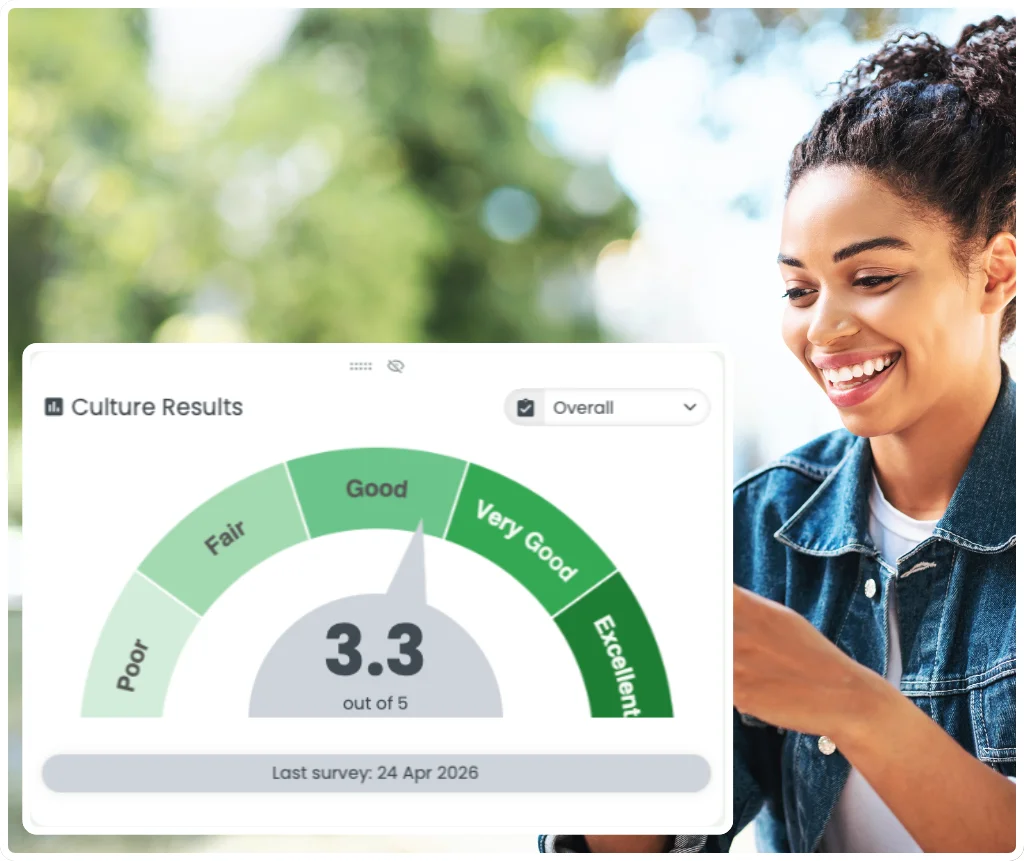
Shift workers do not fill in forty-question annual surveys. Short pulses in the app they already use get answered — and the trend tells you which site has a problem while you can still do something about it.
-
Delivered in the app staff already use for rosters
-
Short and repeatable, so you get a trend not a snapshot
-
Results comparable by team and location




Four moments worth surveying
Timing does more work than question design. Asked at the right moment, four questions will tell you more than forty asked in November.
After onboarding
Did the first few weeks match what they were told at the interview? This is the survey that catches a broken induction while the person is still there.
On a regular pulse
A short, repeated set of questions gives you a trend line. A long annual survey gives you one data point and a spreadsheet nobody opens.
After a change
A new roster pattern, a new site, a new manager. Asking straight afterwards tells you whether the change landed the way you intended.
At the exit
The only time you can ask why someone is leaving. Ask it the same way every time and it becomes a pattern instead of an anecdote.
Engagement is a duty, not an initiative
A PCBU must engage with workers on matters affecting their health and safety and give them reasonable opportunities to participate in improving it. Health includes mental health, so fatigue, workload and bullying are risks to be managed rather than culture topics. Asking is part of managing them.
What the answers are usually telling you
- One site scoring well below the others — almost always a management issue, not a staff one
- Rostering fairness raised repeatedly — who gets the good shifts, and how that is decided
- Short notice of shifts, which shows up as unavailability before it shows up as resignations
- New starters answering differently from staff over a year — an induction problem
Survey answers are most useful next to the operational data — the absence pattern and the roster history that either confirm or contradict what people are telling you.
Why shift-worker surveys usually fail
Sent to a work email
Casual and part-time staff often do not have one, or never open it. The roster app is where they already are.
Too long
A survey that takes fifteen minutes gets answered by the people with fifteen minutes, which is not a representative sample.
Run once a year
One data point is not a trend. You cannot tell whether a score of 6 is a recovery or a decline.
Explore related features
Discover other RosterElf features that work great together
Find out what your team would tell you
Short surveys delivered in the app they already use, with results you can compare across sites.
Feedback and communication guides
Getting honest answers, and what it costs when you do not.

Using staff feedback to improve communication
How to gather feedback that people actually give, and act on it.
Read article
The real cost of poor staff communication
No-shows, confusion and turnover — the bill for communication that is not working.
Read article
Attendance patterns that signal burnout
The absence trends worth acting on before they become resignations.
Read articleCulture survey FAQ
- Engaging with workers is. Sections 58 and 59 of the Health and Safety at Work Act 2015 require a PCBU to engage with workers on matters affecting their health and safety and to have practices giving them reasonable opportunities to participate. "Health" includes mental health, so work-related stress, fatigue and bullying sit inside that duty. A survey is one practical way of meeting it, alongside toolbox talks and direct conversation.
- Be careful what you promise. In a team of six, free-text answers are often identifiable no matter what the system says. Tell staff plainly how responses will be handled and who will see them, and report results at a level that keeps that promise. Under the Privacy Act 2020 an assurance about how personal information will be used is a commitment, not a courtesy.
- Short and regular beats long and annual. People working shifts answer a three-question pulse on their phone between tasks; they do not complete a forty-question form. The value is in the trend, which needs repetition more than it needs length.
- Then do not run the survey. Asking and doing nothing is worse than not asking, because it teaches staff that feedback goes nowhere — and the next survey gets a lower response rate and less honest answers.