

Holidays Act leave, tracked against the roster
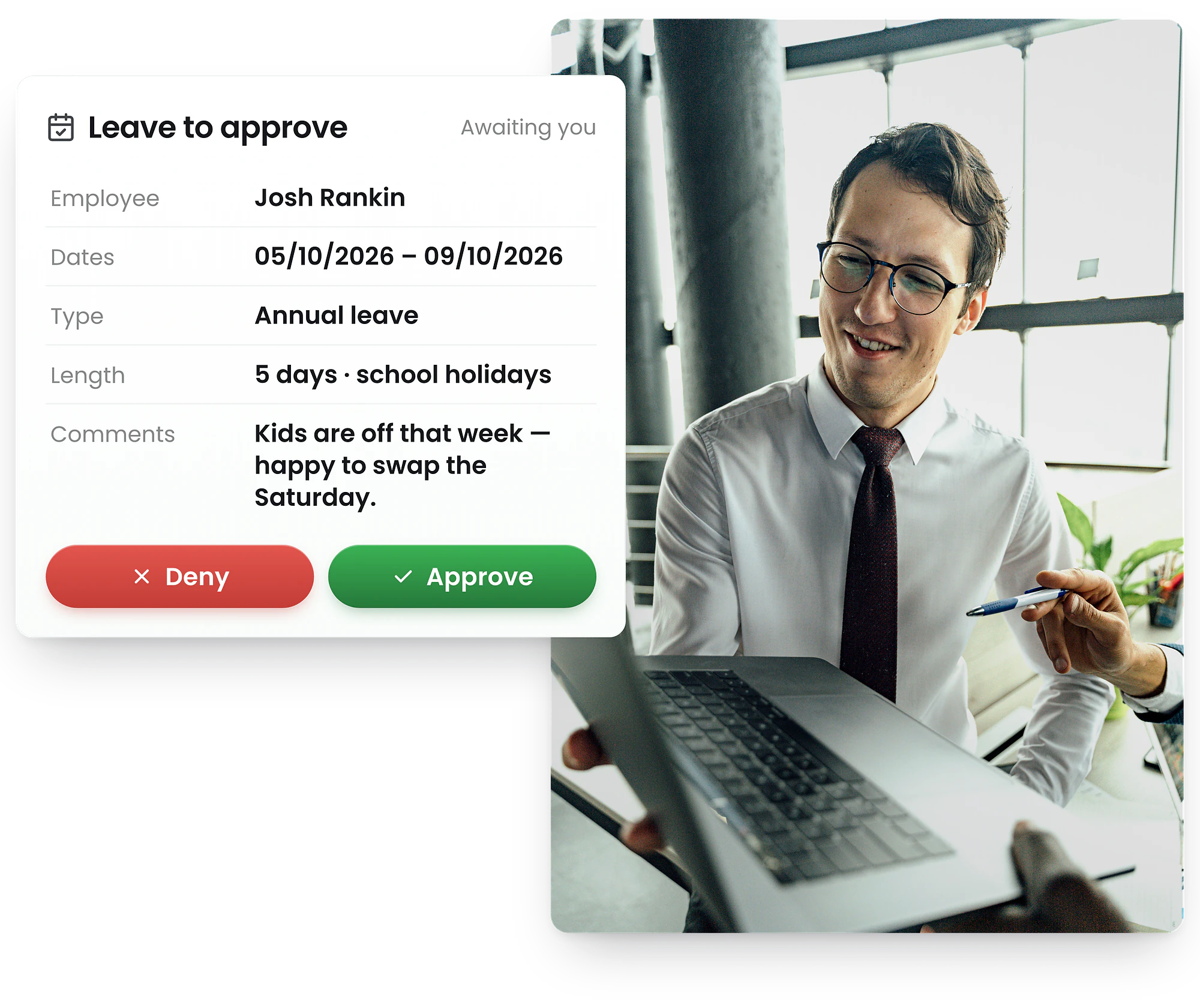
Annual holidays, sick leave, bereavement leave, family violence leave and public holidays — requested from the app, approved against the roster, and backed by the hours history the calculations depend on.
-
Four weeks annual holidays and 10 days sick leave, tracked per employee
-
Work-pattern history for otherwise-working-day decisions
-
Ready for the hours-based accrual arriving in 2028




The New Zealand entitlements
New Zealand has no National Employment Standards, no combined personal/carer’s leave, no leave loading and no long service leave. These are the entitlements that actually apply.
4 weeks
Annual holidays
After 12 months’ continuous employment. Paid at the greater of ordinary weekly pay and average weekly earnings — which is why a spreadsheet that stores a single hourly rate cannot calculate it.
10 days
Sick leave
After six months’ employment, then for each following 12 months. Untaken days carry over, up to a maximum entitlement of 20 days at any one time.
On qualifying loss
Bereavement leave
Available after the same six-month qualifying period, with the number of days depending on the relationship to the person who died.
Up to 10 days
Family violence leave
A distinct entitlement in New Zealand law, separate from sick leave, and available after the same qualifying period.
11 + anniversary
Public holidays
Eleven national public holidays plus your regional anniversary day. What is owed depends on whether the day was an otherwise working day for that employee.
A day in lieu
Alternative holidays
Working a public holiday that is an otherwise working day earns at least time and a half for the hours worked, and a whole alternative holiday to take later.
General information, not legal advice. Entitlement detail is published by Employment New Zealand at employment.govt.nz.
The calculation depends on data most businesses do not keep
Holidays Act non-compliance is rarely a decision to underpay. It is almost always a data problem: the entitlement is defined in weeks and days, the payment is defined by comparing two different averages, and both depend on what the employee actually worked over the preceding year.
What the calculation needs, and where it usually is
- A full 12 months of gross earnings — usually in payroll, but not linked to the leave record
- The employee’s actual work pattern — usually only in old rosters, if anywhere
- Whether a given date was an otherwise working day — usually reconstructed from memory
- Which hours were worked on a public holiday — usually in timesheets nobody kept
RosterElf holds the roster and timesheet side of that list, and keeps it against the employee for the six years New Zealand law requires. The payment itself is calculated in payroll — but payroll can only be as right as the hours it is given.
Related support articles
Step-by-step guides to help you get started
Requesting leave from a smartphone
How an employee submits a leave request from the RosterElf mobile app.
Leave and availability View guideActioning staff leave requests from a browser
How a manager reviews, approves or declines a request and checks roster impact.
Leave and availability View guideProcessing leave for staff on payroll
How approved leave exports to Xero or MYOB with the correct leave code.
Leave and availability View guideLeave types in RosterElf
The leave types available out of the box and how to add your own.
Leave and availability View guideExplore related features
Discover other RosterElf features that work great together
Leave that lines up with the roster
Requests from the app, approvals against the roster, and the hours history behind every Holidays Act calculation.
Leave and absence guides
Balances, absences and the attendance patterns worth watching.

How to track and manage employee leave balances
How leave accrues, how to track balances accurately, and where payouts go wrong.
Read article
Managing unplanned absences without disrupting operations
Backup rosters, notification protocols and cross-training that actually hold up.
Read article
Attendance patterns that signal burnout
The absence trends worth acting on before they become resignations.
Read articleLeave management FAQ
- Four weeks of annual holidays after 12 months of continuous employment, under the Holidays Act 2003. "Four weeks" is a weeks-based entitlement, not a fixed number of hours — for someone whose hours vary, a week is worked out from their actual pattern of work, which is where most manual calculations go wrong.
- At the greater of the employee’s ordinary weekly pay and their average weekly earnings over the previous 12 months. Both have to be calculated and compared for every leave payment. Where only one is stored, the employee is underpaid whenever the other would have been higher.
- Ten days per 12-month period, starting after six months of employment. Unused days carry forward, but the total entitlement an employee can hold at any time is capped at 20 days.
- It is the test for whether a day would have been a working day for that employee had the public holiday or leave not intervened. It decides whether a public holiday is paid, whether an alternative holiday is earned, and whether a sick day is paid. For fixed rosters it is obvious; for variable rosters it is answered by looking at the employee’s actual work pattern — which is precisely what your roster history is.
- Pay-as-you-go holiday pay is limited to narrow circumstances — genuine fixed-term employment of less than 12 months, or work that is genuinely so intermittent or irregular that annual holidays cannot practicably be provided. It must be agreed in the employment agreement and shown separately on the payslip. Applying it broadly to casuals who in fact work a regular pattern is one of the most common Holidays Act errors.